
Meditation music for sleep and relaxation works by slowing brain wave activity through repetitive, ambient soundscapes typically set between 60-80 beats per minute, often incorporating binaural beats, nature sounds, and sustained harmonic tones that guide listeners from beta to alpha and theta states. For musicians and industry professionals facing irregular touring schedules, late-night studio sessions, and the perpetual glow of blue-lit screens, this genre offers more than consumer benefit. It represents a rapidly expanding market segment where understanding both the science and business model can inform your creative recovery practice and open revenue streams through streaming platforms, sync licensing, and wellness partnerships.
The global sleep and relaxation music market has grown substantially as listeners seek non-pharmaceutical solutions to sleep disorders and stress management. Canadian artists are particularly well-positioned in this space, with several composers and producers building sustainable careers creating ambient soundscapes for meditation apps, wellness brands, and therapeutic settings. This isn’t background music relegated to elevator status. Properly crafted sleep music requires sophisticated understanding of psychoacoustics, frequency response, and the delicate balance between engagement and sedation.
From a rights management perspective, sleep music presents unique opportunities and challenges. Tracks often run 30 minutes to several hours, stream repeatedly throughout night hours, and appear in curated playlists that generate consistent royalty payments. However, the genre’s contemplative nature means fewer performance rights triggers and different licensing structures than traditional compositions. Whether you’re seeking personal solutions for tour recovery or exploring this genre as a creator, understanding how meditation music functions both physiologically and commercially provides a complete picture of its role in the contemporary music landscape.
The Science Behind Meditation Music and Sleep Quality
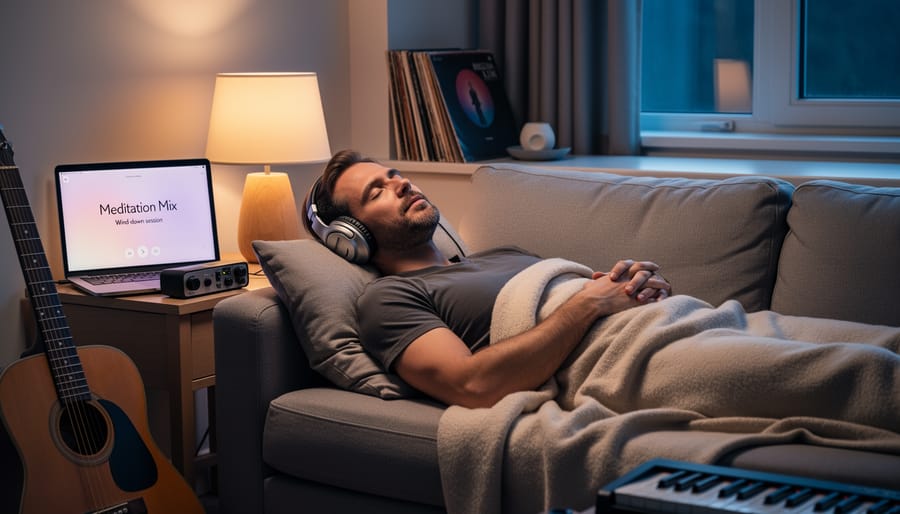
How Sound Frequencies Affect Brain Waves
Your brain operates on electrical rhythms that shift throughout the day, and these rhythms determine whether you’re alert, drowsy, or deeply asleep. When you’re awake and focused, your brain generates beta waves (13-30 Hz). As you relax, you drop into alpha waves (8-12 Hz), a calm-but-aware state. Drifting toward sleep, you enter theta territory (4-7 Hz), where thoughts become dreamlike and the conscious mind loosens its grip. Deep, restorative sleep occurs in the delta range (0.5-4 Hz), when your brain waves are at their slowest and your body repairs itself.
Meditation music designed for sleep typically features frequencies and patterns that mirror these slower brainwave states. Research using SWS brain-wave music EEG analysis has shown that listening to music embedded with low-frequency tones can encourage the brain to synchronize with those slower rhythms, a process called entrainment. For musicians, whose brains are wired to parse harmony, melody, and structure, this entrainment effect can be particularly useful. A composition hovering around 60 BPM with sustained tones in the delta or theta range gives your analytically-trained mind something neutral to track, nudging it away from beta-wave alertness without triggering the kind of melodic interest that keeps you mentally engaged.
The Role of Predictability and Repetition
For most listeners, predictable musical patterns create boredom. For musicians trying to sleep, that’s exactly the point. Your brain constantly scans for novelty, changes in key, unexpected chord progressions, or rhythmic variations. When meditation music eliminates these elements, it removes the cognitive hooks that keep your analytical mind engaged. Research shows that music mindfulness reduces distress partly because predictable structures allow mental focus to shift inward rather than tracking external musical development.
This matters particularly if you’ve spent years training your ear to identify chord substitutions, voice leading, or production techniques. A well-crafted pop song will keep you alert, mentally cataloguing the pre-chorus build or analyzing the mix. Sleep-focused meditation music deliberately avoids development. It presents a sonic environment, not a composition. The same drone holds for minutes. Timbral shifts happen so gradually you can’t pinpoint when they occurred. There’s no verse-chorus structure creating anticipation, no dynamic arc building toward resolution.
Think of it as white noise with tonal character. The repetition becomes a placeholder for your attention, occupying just enough mental bandwidth to prevent racing thoughts without providing enough stimulation to trigger active listening. Your musician’s brain, accustomed to seeking patterns and predicting what comes next, finds nothing to predict and eventually stops trying. That cognitive surrender is precisely what allows the transition into sleep states.
Composition Elements That Make Sleep Music Effective
Tempo and Rhythm Considerations

For sleep-focused meditation music, the ideal tempo sits between 60 and 80 beats per minute, mirroring a resting heart rate. Research confirms that slow tempo improves sleep quality by encouraging physiological synchronization. Below 60 BPM, the body begins to entrain to the slower pulse, gradually reducing heart rate and respiratory patterns.
However, the most effective sleep music often eliminates explicit rhythm entirely. A steady pulse, no matter how slow, can engage the brain’s pattern-recognition systems. Musicians especially find this challenging, since we’re trained to lock into rhythmic structures. Ambient drones, sustained tones, and gradual harmonic shifts work better than metronomic patterns because they avoid creating anticipation or mental tracking.
When rhythm does appear, it should be subtle and irregular enough to prevent active listening. Think gentle, arrhythmic swells rather than steady quarter notes. The goal is to provide sonic texture without giving the mind something to follow or analyze, allowing consciousness to drift rather than engage.
Harmonic Structure and Tonal Choices
Sleep-effective meditation music typically relies on consonant intervals, perfect fifths, octaves, and major thirds, because these harmonies require minimal cognitive processing. When you hear a dominant seventh chord resolving to the tonic, your musical training kicks in; your brain anticipates, analyzes, and experiences satisfaction at the resolution. That active engagement works against the mental quieting needed for sleep.
Drone-based compositions eliminate this analytical cycle entirely. A sustained fundamental tone with slowly shifting overtones provides harmonic interest without creating expectation. Many sleep compositions use pedal points that remain constant while upper voices add subtle color through suspended fourths or added ninths that never demand resolution.
Modal scales, particularly Dorian and Mixolydian modes, appear frequently in meditation music because they lack the strong leading-tone pull of major and minor scales. The flattened seventh in Mixolydian, for instance, removes the urgency to resolve upward, allowing phrases to simply exist rather than drive toward a destination.
Composers working in this genre often avoid chord progressions altogether, instead layering sustained tones at carefully chosen intervals. This approach creates what acousticians call a “spectral envelope”, a stable harmonic environment where the brain can rest rather than predict what comes next.
Instrumentation and Sound Selection
Certain instruments naturally lend themselves to sleep music because of their acoustic properties and sustained tonal characteristics. Synthesizers dominate the genre, particularly those capable of producing warm, evolving pads with minimal harmonic movement. The ability to sustain notes indefinitely and layer multiple frequencies creates an enveloping sonic environment without jarring attacks or decays.
Singing bowls and similar resonant instruments produce complex overtone series that engage the ear without demanding analytical attention. Their gradual fade mimics natural decay patterns that the brain finds inherently soothing. These acoustic elements often appear layered beneath electronic foundations, adding organic texture.
Nature sounds serve a specific function beyond mere ambiance. Rain, ocean waves, and forest atmospheres provide non-repeating patterns that mask environmental noise without creating rhythmic expectation. The brain recognizes these as non-threatening environmental markers, which can lower stress response.
Ambient pads built from processed acoustic sources occupy the middle ground. A cello note stretched and filtered beyond recognition maintains warmth while losing its identifying character. This abstraction prevents the musician’s analytical mind from focusing on technique or composition choices.
The most effective sleep music combines multiple layers at different frequency ranges, creating fullness without complexity. Low drones anchor the mix, mid-range pads provide body, and high ethereal tones add air without brightness.
Sleep Challenges Unique to Musicians and Music Professionals
The Post-Performance Wind-Down
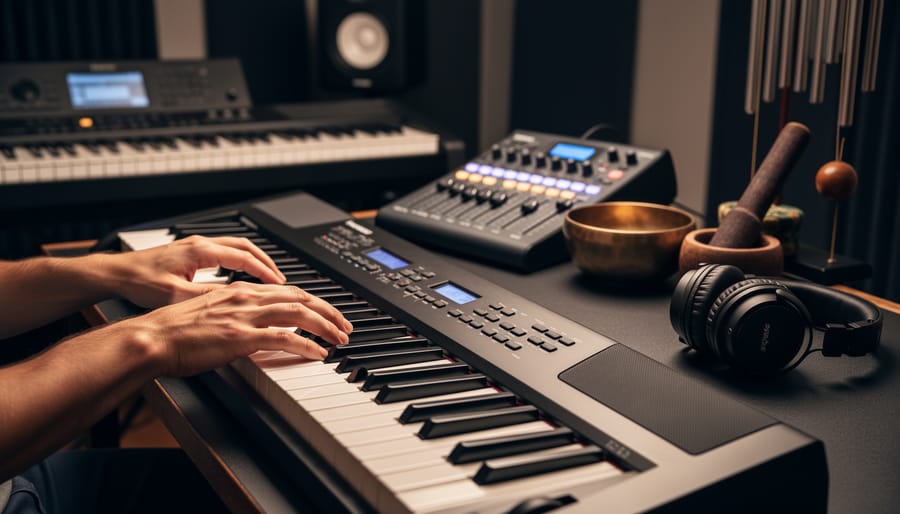
The hours immediately following a performance present a unique physiological challenge. Adrenaline levels remain elevated, the nervous system stays activated, and your mind replays musical moments or audience reactions. This post-show surge can keep you wired until 3 or 4 a.m., even when you’re physically exhausted and need to travel the next morning.
Meditation music helps reset this overactive state by providing an acoustic environment that signals safety and rest. The consistent, low-stimulation soundscape gives your analytical musical brain something neutral to process, preventing it from cycling through performance details or tomorrow’s setlist. Within 20 to 30 minutes of listening, most musicians notice a shift from mental replay to physical relaxation.
The key is starting the music before you feel sleepy. Many touring artists create a post-show routine: change clothes, hydration, then meditation music at low volume while doing basic tasks. This conditions your nervous system to associate the sounds with winding down rather than trying to force sleep when you’re still buzzing.
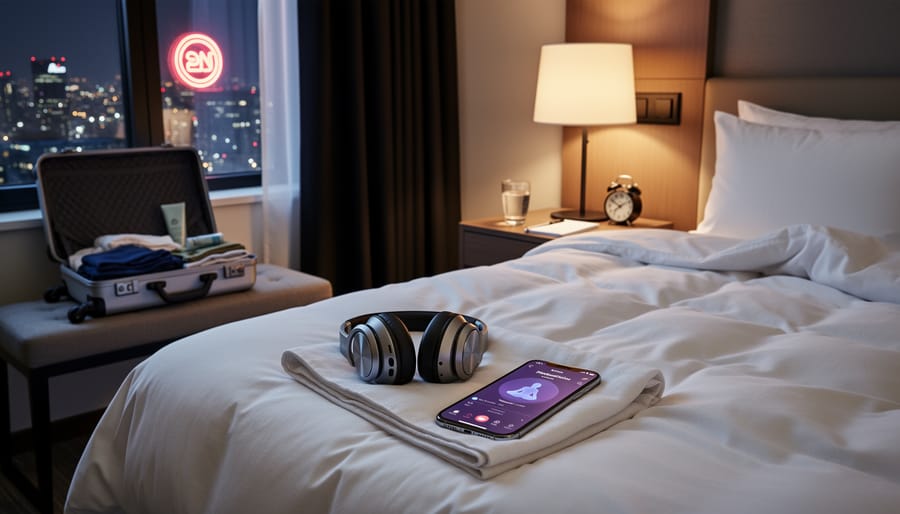
Canadian artists touring internationally face the added challenge of new hotel rooms every night. The familiarity of your chosen sleep music becomes an anchor, a consistent acoustic signal that helps override the alertness that comes from unfamiliar surroundings. Your body learns to recognize these specific sounds as permission to let go of the performance energy and transition toward rest.
Managing Irregular Schedules
Touring musicians face a perpetual challenge: their bodies never quite know what time zone they’re in or when sleep should happen. One night you’re performing in Vancouver at 11 PM, three days later you’re wrapping up a festival set in Berlin at 2 AM local time, and your circadian rhythm has no anchor point. This is where meditation music becomes more than a relaxation tool, it transforms into a portable sleep signal your body can recognize regardless of geography.
The key is consistency. When you use the same meditation music or playlist every time you prepare for sleep, you’re essentially training your nervous system to associate those specific sounds with rest. Your brain begins responding to the familiar frequencies and patterns as a cue to initiate sleep processes, even when everything else, the hotel room, the ambient noise, the time on the clock, is unfamiliar.
Canadian artists working international markets particularly benefit from this approach. Whether you’re managing showcases during MIDEM in Cannes or touring festivals across Asia, carrying your sleep music creates a dependable ritual. The music becomes your anchor, signaling to your body that despite the time zone chaos, this is sleep time now.
Practical implementation matters: use the same playlist, start it at the same point in your pre-sleep routine (after brushing teeth, while dimming lights), and maintain consistent volume levels. This ritualistic repetition strengthens the association, making your meditation music increasingly effective as a sleep trigger even when your schedule remains wildly irregular.
Rights, Royalties, and the Business of Sleep Music
The Streaming Economy of Sleep Playlists
The meditation and sleep music category generates billions of streams annually, but the economics reveal significant disparities in how artists are compensated. Unlike traditional songs that listeners play once or twice, sleep tracks often run for several hours continuously, yet streaming platforms count only a single play regardless of duration. An 8-hour ambient composition that helps someone sleep through the night earns the same per-stream royalty as a 3-minute pop song played once.
This structural inequity in royalty calculation affects Canadian composers significantly. While a sleep playlist might accumulate massive play counts, the revenue per listener remains surprisingly low. Some platforms have attempted to address this through time-weighted royalty models, but implementation remains inconsistent across services. The challenge intensifies when considering that sleep music listeners often engage with the same tracks repeatedly over months or years, potentially generating substantial value without proportional compensation to creators.
Canadian composers entering this space should understand these dynamics before committing resources. The opportunity exists in volume and consistency rather than per-stream rates. Successful sleep music artists build extensive catalogs across multiple platforms, diversify their presence internationally, and ensure their works are registered properly with performing rights organizations like SOCAN to capture all available revenue streams.
The meditation music market continues expanding globally, creating openings for Canadian artists who understand both the creative requirements and business realities. Organizations advocating for fair compensation are increasingly examining how streaming models can better serve ambient and functional music creators.
International Market Opportunities
The global wellness industry topped $5.6 trillion in recent valuation, with meditation and sleep music representing one of its fastest-growing segments. Canadian composers and producers are well-positioned to capture international revenue streams, but many overlook the administrative steps that unlock payments from overseas usage.
Streaming platforms operate globally, meaning a sleep track released by a Toronto-based artist might accumulate millions of plays across European, Asian, and Latin American markets. Without proper international rights registration, those streams generate royalties that sit unclaimed in foreign collection societies. Working with music rights groups that maintain reciprocal agreements worldwide ensures you receive payment regardless of where listeners press play.
Certain territories show particularly strong demand for meditation content. Japan’s wellness sector has embraced sleep music as part of broader self-care practices, while Scandinavian countries demonstrate high per-capita streaming of ambient and relaxation genres. German and UK markets feature extensive meditation app ecosystems that license tracks for guided sessions and background soundscapes.
Canadian artists should register works with both domestic collection agencies and understand which international societies their representatives have agreements with. For composition-focused sleep music, mechanical and performance rights span multiple territories. Tracks featuring nature sounds or field recordings may require additional clearances depending on where source material was captured.
The meditation music market rewards consistency and catalog depth. Artists producing cohesive albums or series of related tracks often see better playlist placement than single releases, particularly on international platforms where curators build multi-hour programming. Strategic metadata tagging in multiple languages helps international discovery, as does understanding peak listening hours across time zones when promoting new releases.
Creating Your Personal Sleep Music Practice
Building a consistent sleep music practice requires experimentation and intentional structure. Start quietly, around 30-40 decibels (about the volume of a whisper or soft rainfall), to avoid triggering your analytical listening habits. Musicians often make the mistake of listening too critically, dissecting production choices instead of letting the sound wash over them. If you catch yourself analyzing the mix or arrangement, the volume is probably too high or the music too complex.
Begin your routine 45 to 60 minutes before your target sleep time. This window accounts for the physiological transition your body needs, especially after late rehearsals or gigs when adrenaline is still circulating. Playing meditation music earlier signals your nervous system that the performance day has ended, creating a buffer between your professional brain and rest mode.
To establish an effective practice:
- Choose a consistent 20- to 30-minute track or playlist as your primary sleep cue, playing it at the same time each night to build association between the specific sounds and sleep onset.
- Set your playback to stop after 60 to 90 minutes rather than looping all night; research shows the sleep-induction benefit occurs mainly during the falling-asleep phase, and continuous playback can disrupt later sleep cycles.
- Position your speaker or device at least three feet from your head to prevent the music from becoming too present or directional, which can keep you cognitively engaged.
- Track your sleep quality for two weeks using a simple journal note (how long to fall asleep, how rested you feel), then adjust volume, duration, or music selection based on patterns.
- Create backup options for touring by downloading offline playlists, since streaming access varies internationally and searching for sleep music at 2 a.m. in an unfamiliar hotel defeats the purpose of a pre-established routine.
Avoid meditation tracks with sudden dynamic shifts, vocal guidance, or recognizable melodies from your professional work. Your brain will engage with familiar musical material instead of releasing into rest. If you’re composing in this space and considering album art for sleep music or developing sleep playlist branding apply the same minimalist principles: visual calm supports the sonic calm you’re creating.
The goal isn’t perfect sleep from day one. You’re retraining your response to sound, shifting from active listening to passive reception. Give the practice three weeks of consistency before deciding whether the approach works for your particular sleep challenges.
Meditation music occupies a unique position in today’s music landscape. For musicians and industry professionals, it addresses a genuine need, helping minds trained to dissect complex arrangements finally quiet down enough to sleep. The science backs this up, and the personal benefits are real, particularly for artists managing irregular schedules and the physiological aftermath of performance.
But there’s another layer here that matters just as much. As streaming platforms continue to reshape how music generates revenue, the meditation and sleep music genre represents a significant commercial opportunity. Canadian composers and producers are well-positioned to contribute to this global market, but only if the rights infrastructure supports them properly.
The same 8-hour ambient track that helps a touring musician recover in a hotel room also generates royalties, potentially for years, as it accumulates streams from listeners worldwide. This makes accurate rights registration, transparent royalty collection, and international agreements more important than ever. Too many creators in the wellness music space have seen their work generate millions of streams without receiving fair compensation because they didn’t understand the licensing landscape or protect their rights internationally.
This is exactly where organizations focused on artist advocacy become essential. As the meditation music market grows across borders, ensuring Canadian musicians receive what they’ve earned, whether they’re creating this music or simply using it to maintain their health, remains fundamental to a sustainable creative career.