
Lyophilized peptides are the better default for almost every lab working with research peptides with public COAs because freeze-drying removes the water that drives most degradation and gives you a far longer shelf life than a liquid solution. Liquid formats win only in narrow cases, such as short-term work where you need a ready-to-use solution and will finish the vial within days or weeks. That makes this guide most useful for researchers and lab professionals in Canada and abroad who are deciding what to order, how to store it, and how much stock to hold.
The reasoning is simple. Water allows hydrolysis, oxidation and microbial growth, so a peptide sitting in solution starts losing integrity almost immediately, even in the fridge. A dry powder, stored cold and sealed, stays stable for much longer. Choosing well protects your data, your budget and your team workflow, since a degraded batch can quietly undermine weeks of results. If you can verify purity before the format question even matters, you start from a much safer position.
Below, we compare both formats on shelf life, chemical and physical degradation, contamination risk and shipping, then match each to the kind of work it suits best.
Lyophilized vs. Liquid Peptides at a Glance
For researchers who need the core answer fast, the comparison below sets the two formats side by side. Think of it as a quick reference before we explain the reasons behind each difference in the sections that follow.
| Factor | Lyophilized Peptides | Liquid Peptides |
|---|---|---|
| Typical storage temperature | Freezer for long-term storage; cool, dry conditions for short periods | Refrigerator for short-term use; freezer for stock solutions |
| Expected shelf life | Months to years, depending on sequence and supplier guidance | Days to weeks, and shorter once opened or thawed |
| Main degradation risks | Moisture uptake if the vial is opened or sealed poorly | Hydrolysis, oxidation, aggregation, microbial growth, freeze-thaw damage |
| Ease of use | Requires careful reconstitution before use | Ready to use, with minimal preparation |
| Best-fit scenario | Long-term banking and infrequent use | Short, high-frequency, ready-to-use workflows |
The pattern is consistent: lyophilized peptides protect your material over time, while liquid peptides save preparation effort at the cost of a much shorter window of reliability. Exact figures vary by amino acid sequence, formulation and storage conditions, so always confirm timelines against your supplier’s documentation. The rest of this article explains why these differences exist and how to choose between the formats with confidence.
What Each Peptide Format Is
Lyophilized (Freeze-Dried) Peptides
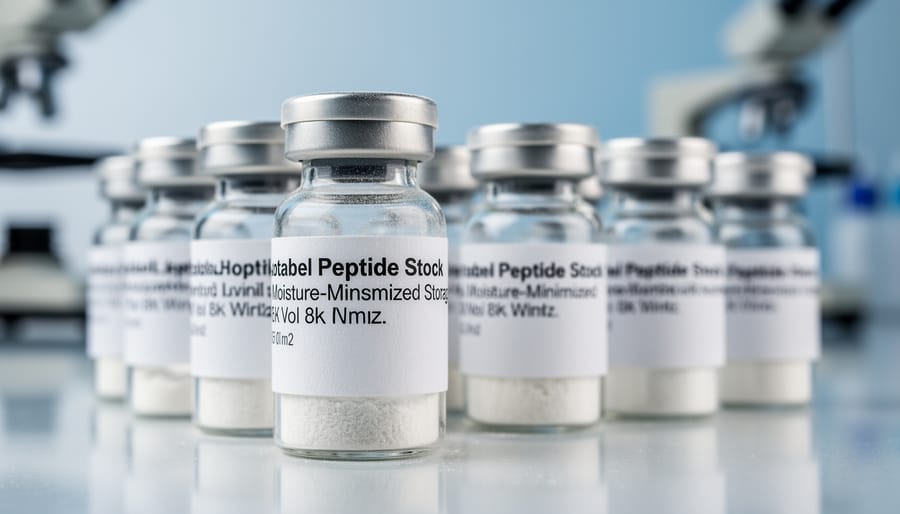
Lyophilization, better known as freeze-drying, removes water from a peptide solution without ever heating it. The solution is frozen solid, then placed under a strong vacuum so the ice turns straight into vapour and leaves the container. A final drying stage pulls off the small amount of water still clinging to the peptide.
What remains is a dry, lightweight powder or a loose, porous “cake” at the bottom of the vial. It is usually white or off-white and takes up very little space. That fluffy structure is a good sign, because it dissolves readily when the researcher adds solvent later.
Water is the key to why this matters. Most of the reactions that break peptides apart need water to take place, so taking it away slows those reactions dramatically. A few terms come up repeatedly in this discussion:
- Lyophilization (freeze-drying)
- A process that freezes a solution and then removes the ice under vacuum, leaving a dry peptide powder or cake.
- Reconstitution
- Dissolving the dried peptide in a suitable solvent to return it to liquid form before use.
- Hydrolysis
- A reaction in which water breaks the chemical bonds that hold a peptide chain together.
- Excipient or buffer
- An added ingredient that helps hold the peptide’s structure and the solution’s acidity steady during freezing and drying.
Because the peptide sits in a dry, stable state, lyophilized material generally tolerates storage far better than the same peptide in solution, provided the vial stays sealed and dry.
Liquid (Reconstituted or Ready-to-Use) Peptides
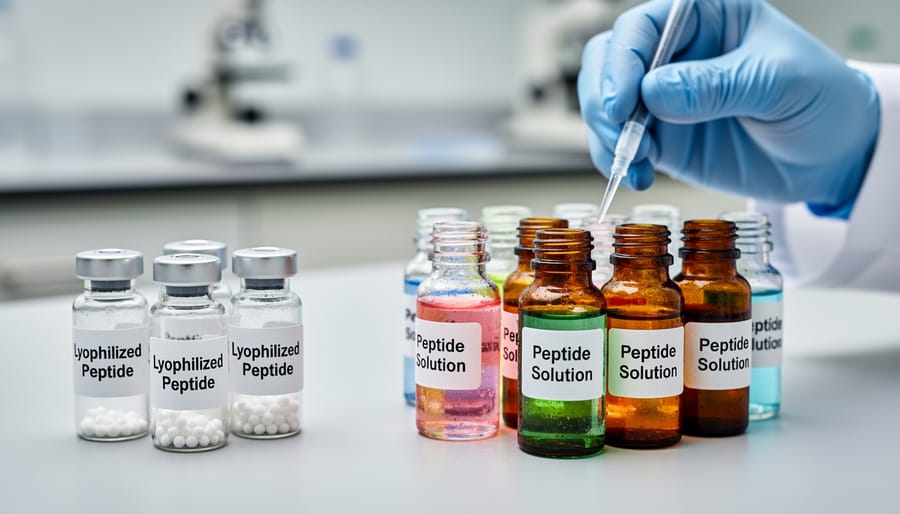
Liquid peptide preparations come in two common forms. The first is a lyophilized peptide that a researcher has reconstituted, meaning the powder has been dissolved in a chosen solvent such as sterile water or a buffer. The second is a pre-made solution, supplied already dissolved and ready to pipette. Both save time at the bench, and that convenience is the main reason labs choose them.
The trade-off comes from the very thing that makes them easy to use: the peptide is now surrounded by water. In a dried powder, individual molecules sit locked in a solid matrix with little freedom to move or react. In solution, they move freely, collide more often, and come into constant contact with water, dissolved oxygen, and any trace contaminants. Many of the chemical reactions that break peptides down, including hydrolysis, oxidation, and deamidation, need exactly that kind of mobile, water-rich environment to proceed.
Solution conditions add further variables. The pH of the buffer, the storage temperature, and the presence of metal ions can each speed up or slow down degradation, and the effect differs from one sequence to the next. A peptide that holds up well in a mildly acidic buffer may deteriorate quickly at neutral pH.
Liquids are also open to risks that dry powder largely avoids. Dissolved peptides can support microbial growth if sterility is not maintained, and they can stick to the walls of tubes and vials, reducing the effective concentration over time.
None of this makes liquid peptides a poor choice. It simply means they are best treated as a short-term working format, prepared with care and used within a defined window, rather than as something to bank for months.
Lyophilized vs. Liquid Peptides, Dimension by Dimension
Shelf Life and Storage Temperature
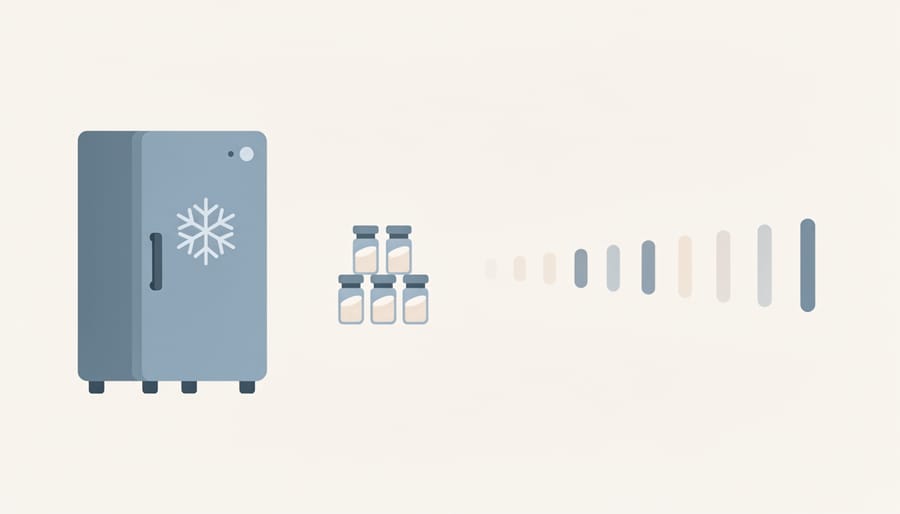
Shelf life is where the two formats separate most clearly. Lyophilized peptides are typically held in a freezer, often around -20°C, where they can stay reliable for months to years when kept dry, sealed and protected from light. Liquid peptides, by contrast, are usually kept refrigerated or frozen in small portions, and their dependable window is far shorter, often measured in days to weeks.
Because exact figures depend heavily on the amino acid sequence, always confirm timelines against your supplier’s documentation rather than relying on a general rule. Here are the principles that hold up across most sequences:
- Lyophilized powder stores best in a freezer, sealed tightly and away from moisture and light.
- Lyophilized peptides can usually tolerate room temperature briefly, such as during transit or while being weighed.
- Reconstituted peptides are generally best kept refrigerated and used within a short window.
- Longer storage of liquid stocks calls for frozen, single-use aliquots to avoid repeated freeze-thaw cycles.
- Sequences prone to oxidation or deamidation may need stricter limits in solution.
Think of it as a trade-off between convenience and longevity. The drier and colder a peptide is kept, the longer it holds its integrity, which is why lyophilized material suits banking and infrequent use. Whatever format you choose, record the date received, the date reconstituted and the storage conditions, since that documentation supports reproducibility and helps you judge when a stock should be retired.
Chemical Degradation: Hydrolysis, Oxidation and Deamidation
Three chemical reactions do most of the damage to peptides over time, and water or oxygen drives each one.
Hydrolysis is the simplest. Water molecules attack the bonds linking amino acids, slowly cutting the chain into shorter fragments. Sequences with aspartic acid are especially exposed, because the bond next to it is relatively fragile, particularly in acidic conditions. Oxidation is the second pathway. Dissolved oxygen reacts with methionine and cysteine, converting them into forms that change the peptide’s shape and activity. Tryptophan, tyrosine and histidine can be affected as well. Deamidation is the third. Asparagine and glutamine lose a small chemical group, which converts them into different amino acids. Asparagine followed by glycine is a well-known weak spot, and it can shift a peptide’s behaviour even though the change looks tiny on paper.
In solution, peptide molecules move freely and meet water, dissolved oxygen and trace metals constantly, so all three reactions proceed far more readily. Warmth and unsuitable pH speed them further. This is why a liquid stock can lose potency in weeks, or sooner, even when it looks perfectly clear.
Lyophilization limits these pathways by removing most of the water. Hydrolysis and deamidation both need water as a reactant, and a dry, rigid cake leaves molecules little room to move and react. Oxidation is slowed too, though not eliminated, especially if the vial is sealed under inert gas or the powder absorbs moisture after opening.
Sequence matters as much as format. A peptide rich in methionine, cysteine or asparagine will be less forgiving in solution than one built from more stable residues, so confirm stability guidance with your supplier for your specific sequence.
Physical Stability: Aggregation, Adsorption and Freeze-Thaw Damage
Chemical breakdown isn’t the only way a peptide loses value. Physical changes can quietly erode a sample even when the sequence itself stays intact.
Aggregation is the first concern. In solution, peptide molecules can stick together and form clumps, sometimes visible as cloudiness or particles, sometimes invisible to the eye. Aggregated peptide is often less soluble and less active, and it can skew concentration readings. Lyophilized powder keeps molecules fixed in place, which limits this risk until the peptide is dissolved.
Adsorption is the second. Peptides, especially hydrophobic or highly charged ones, can cling to the walls of tubes, vials and pipette tips. At low concentrations, the loss can be significant, meaning the dose you think you’re using isn’t the dose you have. Low-binding plasticware or appropriate glass can help.
Freeze-thaw damage is the third, and it mainly affects liquid stocks. Each cycle exposes the peptide to ice crystal formation, shifting pH and concentration gradients, all of which encourage aggregation and degradation. A stock thawed ten times is not the same material it was on day one.
This is why aliquoting matters. Divide a liquid stock into single-use volumes before freezing, so each portion thaws only once. It costs a few minutes up front and protects the integrity of the whole batch.
Contamination, Handling and Reconstitution Risks
Liquid peptides carry a built-in contamination risk. Water, nutrients and repeated needle or pipette access create an environment where bacteria and fungi can grow, and microbial enzymes can chew through a peptide long before any visible cloudiness appears. Dry powder is far less hospitable, which is one reason lyophilized stock keeps better between uses.
Reconstitution is where either format can go wrong. Solvent choice matters: some sequences dissolve best in sterile water, others need a dilute acid, a buffer or a small amount of organic solvent. The wrong pH can speed deamidation or leave a peptide stubbornly insoluble. Use sterile technique throughout, including clean vials, fresh tips and gentle swirling rather than vigorous shaking, which can foam and aggregate the peptide.
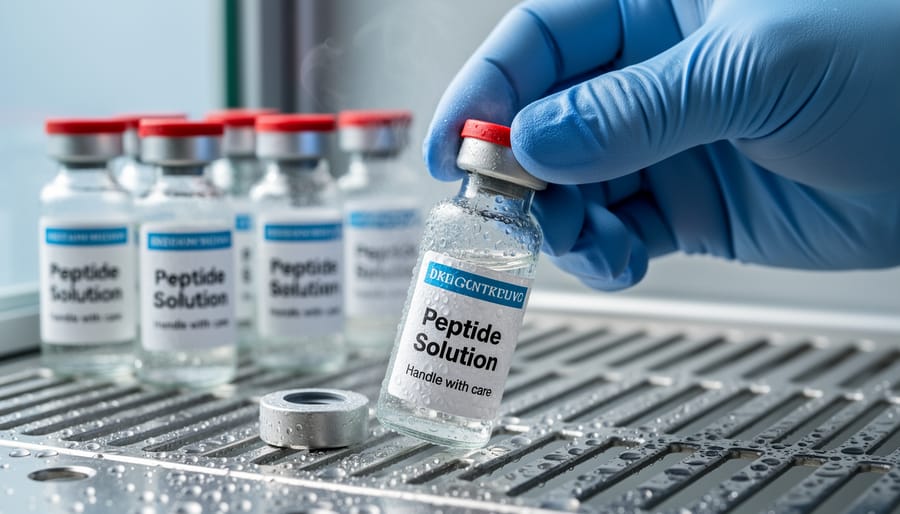
Even a stable lyophilized vial can be compromised by opening it cold, since condensation introduces moisture. Let vials reach room temperature first, and label each aliquot with the date and solvent.
Shipping, Transit and Cost Considerations
Lyophilized peptides generally tolerate transit better. As a dry powder, they can handle brief temperature excursions during cross-border shipping into and within Canada, where customs holds or weather delays can stretch delivery times. Liquid peptides are far less forgiving, so they often need a cold chain, which adds packaging and courier costs. A warm delivery can also mean an entire shipment is wasted and must be reordered. Because stability limits vary by sequence, consult supplier docs for shipping temperature guidance before ordering.
Practical Storage and Handling Practices That Protect Peptide Integrity
Protecting peptide integrity comes down to a handful of habits that cost little and save a great deal. Think of a vial the way a producer thinks of a master recording: once it degrades, no amount of effort brings back the original. Good storage practices are really a form of asset protection.
- Keep lyophilized stock sealed and cold until you are ready to use it.
- Let vials reach room temperature before opening, so condensation does not introduce moisture.
- Aliquot reconstituted peptides into single-use volumes.
- Avoid repeated freeze-thaw cycles, which damage liquid stocks.
- Protect peptides from light, especially sequences prone to oxidation.
- Label every vial with the date of reconstitution.
Record-keeping matters as much as the handling itself. When you document conditions such as storage temperature, thaw dates and lot numbers, another researcher can reproduce your work, and you can trace the cause if a result looks off. A simple log kept beside the freezer is often enough.
Finally, follow your institution’s biosafety and chemical-handling policies, along with any applicable Canadian laboratory guidelines. Supplier documentation should always take precedence over general advice, since stability varies by sequence. Careful, consistent habits protect both your budget and the credibility of your data.
Which Peptide Format Should You Choose?
The right format depends less on which one is “better” and more on how you actually work. Start by asking how long the material will sit before you use it, and how often you will touch it.
If you are banking peptides for months, working through them slowly, or building a reserve you may not open for a while, lyophilized is the sensible default. The dry powder holds up far better in a freezer, and you reconstitute only what a given experiment needs. If your workflow is short, repetitive and fast-moving, with the same peptide used several times a week, a ready-to-use liquid can save preparation time and reduce handling steps, provided you use it within a sensible window and aliquot it to avoid repeated freeze-thaw cycles.
Resources shape the decision too. A small independent team may favour lyophilized stock because it reduces waste and reorders when budgets are tight and freezer space is limited. A large institution with dedicated cold storage, standard operating procedures and high throughput may find liquid formats practical, since volume and staffing absorb the logistics. Neither approach is wrong. What matters is matching the format to your real usage pattern.
Whichever you choose, treat the peptide like any asset worth safeguarding. Careful storage, clear labelling and documented handling are how you protect your work because a degraded sample undermines results no matter how good the design was.
Frequently Asked Questions About Peptide Stability
How long do reconstituted peptides last?
Once a peptide is in solution, its shelf life drops sharply compared with the dry powder, often to days or a few weeks under refrigeration, depending on the sequence. Check the supplier’s data sheet for the figure that applies to your specific peptide.
Can lyophilized peptides sit at room temperature briefly?
Short exposures, such as during shipping or while you weigh a sample, are generally tolerated because the peptide is dry. Return the vial to its recommended storage temperature promptly and keep it sealed to limit moisture uptake.
Can liquid peptides be refrozen?
Repeated freeze-thaw cycles are best avoided, since they can cause aggregation and loss of activity. Divide stock solutions into single-use aliquots before freezing so each portion is thawed only once.
How can I tell if a peptide has degraded?
Cloudiness, visible particles, discolouration or a change in solubility can be warning signs, though degradation is often invisible. Analytical testing, such as HPLC purity checks, is the reliable way to confirm integrity.
When in doubt, consult the supplier’s documentation for sequence-specific guidance, and record your storage conditions so any unexpected results can be traced back with confidence.
Lyophilized peptides remain the stronger choice when stability over months or years is the goal. Removing water slows hydrolysis, oxidation and deamidation, so a well-stored freeze-dried vial protects your investment far longer than any solution can. Liquid peptides still have a place in short-term, ready-to-use work, where convenience justifies a shorter window and a stricter handling routine.
The format you choose matters less than the care you bring to it. Aliquot liquid stocks, keep storage temperatures steady, use sterile technique during reconstitution, and confirm sequence-specific guidance with your supplier’s documentation. Write down what you do, because clear records make results reproducible and problems easier to trace.
Careful stewardship is a shared value with anyone who has ever protected a master recording or a catalogue built over years. Research is no different. Share what works with colleagues, and keep learning from teams across Canada and around the world. Good practices travel best when they are documented and passed along, and the work they protect is worth the effort.