
Audit your music facility’s HVAC systems and commercial dryer vent cleaning schedules now. Studios, rehearsal spaces, and performance venues across Canada waste thousands annually on inefficient climate control while simultaneously creating fire hazards through neglected ventilation maintenance. A thorough assessment identifies air leaks around studio doors, outdated insulation in control rooms, and clogged exhaust systems that force your heating and cooling units to work overtime.
Replace standard incandescent stage and studio lighting with LED alternatives rated for professional music applications. The upfront cost pays for itself within eighteen months through reduced electricity bills and nearly eliminates bulb replacement labor. Many Canadian provinces offer rebates for commercial lighting upgrades in 2026, making this transition financially accessible for independent venues and small studios.
Install programmable thermostats in all climate-controlled spaces and train staff to use zone heating strategically. Recording studios don’t need identical temperatures in storage areas, lounges, and tracking rooms. Setting different zones saves 20 to 30 percent on heating costs during Toronto winters or cooling expenses in Vancouver summers without compromising the stable environment your instruments and equipment require.
Schedule annual electrical inspections specifically focused on high-draw music equipment. Vintage amplifiers, touring rig chargers, and multiple computer workstations create unique load patterns that standard commercial buildings don’t experience. Faulty wiring or overloaded circuits cause equipment damage and pose serious fire risks, yet most musicians operate spaces without professional electrical audits designed for their specialized needs.
These efficiency measures directly impact your bottom line. Lower operating costs mean more resources for artist development, better equipment, and fair wages for session musicians and technical staff.
Why Energy Efficiency Matters to Your Music Career
The monthly rent cheque most musicians focus on represents only part of what their workspace actually costs. Energy bills in rehearsal spaces, studios, and small venues routinely add hundreds, sometimes thousands, of dollars to operational expenses each year, quietly draining resources that could fund new equipment, marketing campaigns, or simply keeping food on the table. For independent artists and collectives managing their own spaces, these costs directly compete with income from music licensing rights and performance fees.
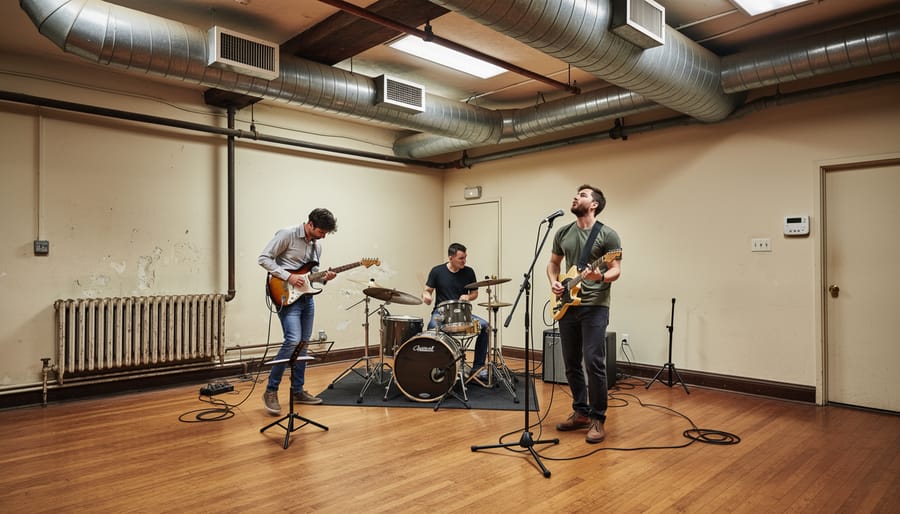
Consider a typical scenario: a four-piece band sharing a 1,000-square-foot rehearsal space in a converted warehouse. Poor insulation means the heating system runs constantly through Canadian winters. Older fluorescent fixtures stay on during all practice sessions. Gear left plugged in draws phantom power around the clock. These seemingly minor inefficiencies compound quickly, HVAC inefficiencies raise costs by 30% or more in commercial buildings, and music spaces face the added burden of heat-generating equipment running for extended periods.
The financial impact extends beyond immediate utility bills. When overhead costs consume a larger percentage of monthly budgets, musicians face harder choices: delay that necessary equipment upgrade, skip the showcase opportunity requiring travel costs, or turn to cash advances against future royalties to bridge gaps. Each dollar saved on energy represents a dollar available for career development, recording sessions, or simply building a financial cushion against the industry’s inherent instability.
For collectives managing shared spaces, energy efficiency becomes a collective sustainability issue. High utility costs either force members to contribute more each month or push the group toward cheaper, often less suitable locations. Musicians already navigate unpredictable income streams and thin profit margins. Reducing fixed overhead expenses through smart energy management directly improves career longevity, transforming workspace costs from a constant drain into a controllable, optimized expense.
Hidden Energy Drains in Music Spaces
Equipment That Runs Hot (And Expensive)
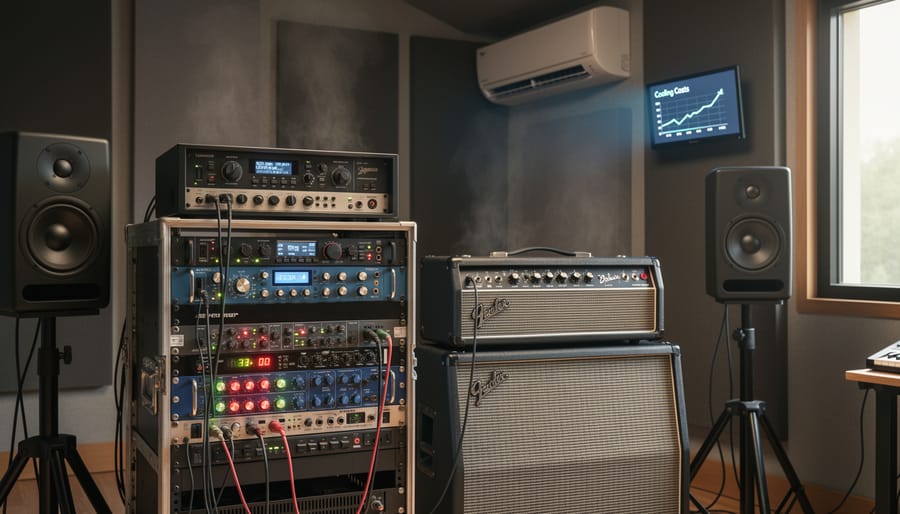
Your vintage tube amp sounds incredible, but it’s also radiating heat like a space heater, and driving up your cooling costs every hour it’s plugged in. A single class-A tube amplifier can generate 150-300 watts of heat continuously, even when you’re not actively playing. Multiply that by the amps, mixing boards, powered monitors, and rack-mounted gear in your studio, and you’ve created a thermal management problem that forces your HVAC system to work overtime.
Computers and digital audio workstations present a different challenge. A high-performance music production computer under heavy load can draw 400-600 watts while rendering tracks or running processor-intensive plugins. Add multiple monitors, external hard drives, and audio interfaces, and you’re looking at significant heat output in spaces that often lack adequate ventilation. Many musicians run these systems in converted rooms never designed for this thermal load.
The phantom power drain compounds the issue. Equipment left in standby mode, that little red light on your amp or the glow from your mixing board’s power button, continues drawing electricity around the clock. A typical home studio might waste 50-100 watts continuously from standby power alone. Over a year, that’s hundreds of dollars literally evaporating.
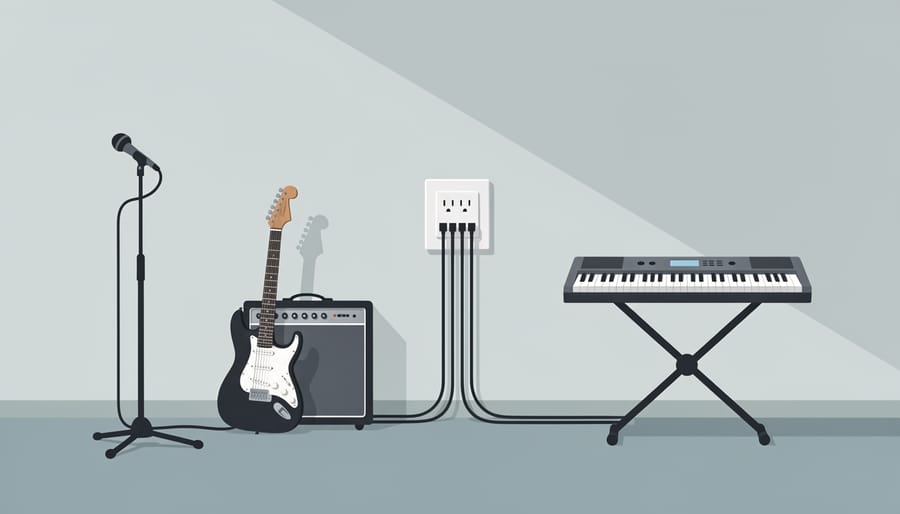
Smart power strips offer a practical solution. Plug your entire signal chain into strips that cut power completely when you’re done working, eliminating phantom drain without wearing out individual power switches. For heat-generating gear, schedule intensive work during cooler hours when your space naturally requires less cooling energy.
Climate Control Challenges for Sound Quality
Acoustic guitars crack. Piano strings go out of tune. Reed instruments warp. The culprit? Poor climate control that treats your practice space like any other commercial unit instead of the specialized environment it needs to be.
Most musicians learn this lesson the expensive way: a beloved instrument damaged because the landlord set the thermostat to “cost-saving” mode during off-hours. Wooden instruments need stable humidity between 40-50%, while most commercial buildings swing wildly from 20% in winter to 70% in summer. Temperature fluctuations stress glues, finishes, and the wood itself.
Here’s the problem: running climate control 24/7 to protect instruments can triple your energy bills. A standard HVAC system cycling on and off creates exactly the swings you’re trying to avoid, while constant operation burns money and energy.
The solution isn’t choosing between your instruments and your budget. Start with a hygrometer in every room where you store instruments, they cost $15 and tell you what’s actually happening, not what the thermostat claims. Many musicians discover their “climate controlled” space varies 30 degrees between ceiling and floor.
Invest in a programmable thermostat that maintains narrow ranges rather than broad swings. Set it to hold 68-72°F year-round instead of the typical 60-78° range most commercial buildings use. The tighter range uses less total energy than dramatic heating and cooling cycles.
Add a standalone humidifier or dehumidifier for your instrument storage area. A small unit running in one room costs far less than forcing your main HVAC system to manage humidity for an entire building. Position it away from instruments to avoid direct moisture contact.
Seal air leaks around doors and windows in your practice space. Weather stripping costs pennies but prevents the outdoor air that destabilizes your carefully managed environment. Your HVAC system works half as hard when it’s not fighting drafts.
Consider room-specific solutions for extreme cases. One Montreal studio installed a small climate-controlled cabinet for vintage guitars, protecting their most valuable instruments while letting the main space run more efficiently.
Practical Energy Upgrades That Pay for Themselves
The fastest way to stop bleeding money is to focus on upgrades that actually generate returns, not just vague environmental virtue. Here’s what works in Canadian music spaces right now.
Start with LED stage and studio lighting. If you’re running a performance venue or rehearsal space with traditional incandescent or halogen lights, you’re throwing away roughly 70% of that electricity as heat. Swap them for LED equivalents, and you’ll cut lighting energy use by 75-80%. For a mid-sized venue running lights six hours daily, that’s $800-1,200 annually back in your pocket. The upfront cost runs $600-2,000 depending on your setup, which means you break even in under two years. Bonus: LEDs run cool, so your air conditioning works less hard during summer August events and winter studio sessions.
Programmable thermostats solve the temperature control problem musicians face when spaces sit empty between sessions. You need proper climate control when people and equipment are present, but there’s no reason to maintain 21°C at 3 a.m. when the building is locked. A smart thermostat learns your schedule and adjusts accordingly. Set it to drop to 15°C overnight and on days you’re not booked, then warm up 90 minutes before sessions begin. In a 150-square-metre rehearsal space, this typically saves $600-900 per year. The device costs $200-350 installed, so you’re looking at a six-month payback.
| Upgrade | Approximate Cost | Annual Savings | Payback Period |
|---|---|---|---|
| LED stage/studio lighting | $600-2,000 | $800-1,200 | 10-18 months |
| Programmable thermostat | $200-350 | $600-900 | 3-7 months |
| Window film/weatherstripping | $300-800 | $400-700 | 12-24 months |
| Power bars with timers | $100-200 | $200-350 | 4-8 months |
| Energy audit | $300-600 | Identifies $1,000+ potential | N/A (diagnostic tool) |
Window treatments make a bigger difference than most musicians realize. If your space has single-pane windows or visible gaps around frames, you’re heating the outdoors. Reflective window film costs $8-15 per square metre and blocks summer heat while retaining winter warmth. Weatherstripping runs about $40-80 for a typical rehearsal room. Combined, these modest investments can cut heating and cooling costs by 15-25%.
For spaces hosting festivals and events or running equipment continuously, power bars with built-in timers eliminate phantom draw from mixing consoles, monitors, and effects processors left in standby mode. A single 19-inch rack of studio gear can pull 40-60 watts around the clock when “off,” which adds up to $50-80 yearly per rack. Timer-equipped power bars cost $15-30 each and pay for themselves in months.
The returns are straightforward. A typical Canadian music space implementing these four upgrades spends $1,200-3,350 upfront and recovers that investment in 12-20 months through lower utility bills. After payback, those savings go straight to better microphones, acoustic treatment, or your own rent.
The Dryer Vent Safety Issue You Can’t Ignore
Most musicians don’t think about dryer vents until there’s a problem. But if you’re working in a multi-use commercial building, say, a rehearsal space that shares walls with a gym, café, or residential loft, a neglected dryer vent can turn into a serious fire risk that affects everyone, including you.
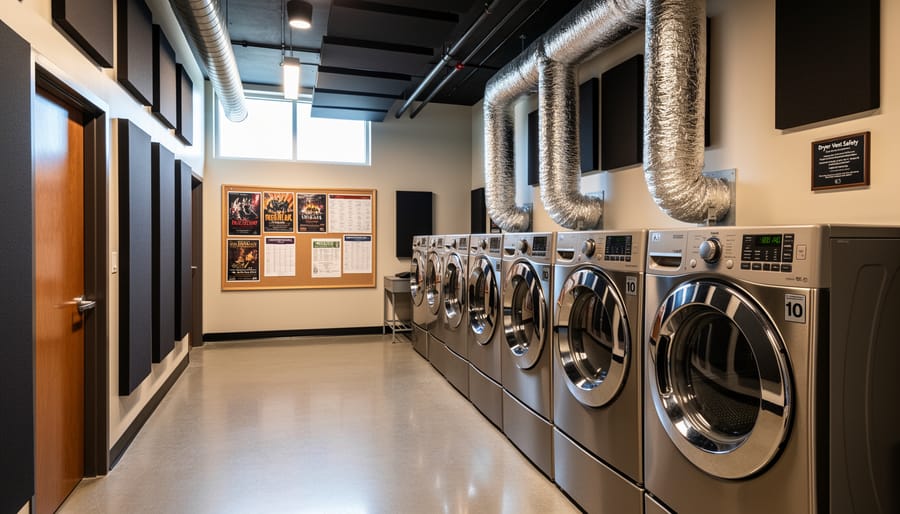
Dryer vents accumulate lint rapidly in commercial settings. A shared laundromat on the ground floor, a live-work studio with washer-dryer hookups, or even a neighboring tenant running laundry services creates conditions where lint buildup happens faster than most property managers realize. Lint is highly flammable. When it restricts airflow, dryers overheat, and that combination ignites an estimated 2,900 fires annually across North America.
The danger intensifies in older converted buildings, former warehouses, factories, and retail spaces now housing rehearsal studios, where ductwork may be longer, poorly installed, or made from outdated materials like plastic or foil. These systems trap more lint and conduct heat differently than modern metal ducts, increasing fire risk substantially.
If you rent space in a multi-tenant building, you might not control the dryer vent maintenance schedule, but you can still protect yourself. Walk the common areas and note where dryer exhaust vents exit the building. If you see excessive lint accumulation on exterior vents or smell burning when dryers are running, report it immediately to your landlord or property manager in writing. Document your concerns with photos and keep copies of all correspondence.
For musicians managing live-work studios with laundry facilities, schedule professional vent cleaning at least once yearly, more often if you’re doing heavy loads regularly. Between cleanings, check the exterior vent monthly for blockages and clean your dryer’s lint trap after every single load without exception.
Fire doesn’t care about your recording schedule or upcoming tour. A vent fire can destroy your gear, your workspace, and your livelihood in minutes. Treat this maintenance seriously.
Safety Checks Every Musician Should Know
Walking into a rehearsal space or studio with your gear shouldn’t mean accepting hidden risks. Most musicians can spot a blown fuse, but comprehensive safety checks go deeper and directly protect both your investment and your life. Whether you manage your own space or rent commercially, these inspections take under an hour quarterly and could prevent catastrophic losses.
Start by treating safety audits as routine maintenance, just like changing guitar strings. The difference is these checks protect everything you own.
- Test all electrical outlets with a circuit tester. These inexpensive devices (under $15) reveal reversed polarity, missing grounds, and open neutrals that create shock hazards. Pay special attention to outlets where you plug in high-draw equipment like amplifiers and PA systems.
- Inspect electrical panels for warning signs. Open the panel door and look for rust, corrosion, burning smells, or scorched marks around breakers. Check that the panel cover is secure and all breaker switches are clearly labeled. If you see multiple circuits labeled “music room” without specifics, that’s a red flag.
- Check emergency exit accessibility. Walk every exit route during setup conditions, when gear is out. Exits must remain unblocked, doors should open easily without keys from inside, and exit signs need working illumination. Storage habits change over time and often gradually block critical pathways.
- Examine extension cord and power strip conditions. Look for frayed insulation, exposed wires, warm-to-touch plugs, or overloaded strips daisy-chained together. Musicians often max out circuits with stacked power demands, creating serious fire risks.
- Verify dryer vent conditions if your building has laundry facilities. Even if you don’t use them, shared buildings with clogged dryer vents pose fire threats. Check that exterior vent flaps open freely and no lint accumulation is visible.
- Test smoke detectors and carbon monoxide alarms monthly. Press the test button on each unit. Replace batteries annually regardless of the low-battery warning. In commercial spaces, confirm you know who is responsible for maintenance.
Document your findings with dated photos stored in cloud backup. This creates accountability if you rent, and tracks deterioration patterns if you own. When you identify issues beyond your scope, especially electrical problems or structural concerns, immediately notify your landlord in writing and follow up until resolved.
Shared commercial buildings present unique challenges since other tenants’ safety practices affect your risk. If you smell gas, see water near electrical equipment, or notice repeated breaker trips, evacuate and contact emergency services. Your gear is replaceable. You aren’t.
Canadian musicians renting commercial space have legal rights to safe working conditions under provincial occupational health and safety legislation. Don’t hesitate to exercise them.
Canadian Incentives and Support Programs for 2026
Musicians and music organizations operating commercial spaces in Canada have access to several funding streams that can offset the cost of energy efficiency improvements in 2026, though navigating these programs requires understanding how arts spaces fit into broader commercial building categories.
At the federal level, the Canada Greener Homes Grant program has expanded to include certain commercial properties under 600 square metres, which covers many small rehearsal studios and practice spaces. Qualifying upgrades include insulation, air sealing, and HVAC replacement, with grants ranging from $125 to $5,000 depending on the improvement. The catch: you need a pre- and post-retrofit energy audit, which costs between $400 and $800, but these audits often reveal additional problems worth fixing.
Natural Resources Canada’s Energy Efficiency for Commercial Buildings Program offers rebates on larger projects exceeding $10,000 in eligible costs. Recording studios with significant HVAC or lighting retrofits may qualify, with rebates covering up to 25% of project costs to a maximum of $75,000. The application process demands detailed energy modelling, so factor in consultant fees.
Provincial programs vary considerably. Ontario’s Save on Energy program provides incentives for commercial lighting upgrades, programmable thermostats, and cooling improvements, particularly relevant for venues running stage lighting and sound equipment. Quebec’s Éco-Performance program offers interest-free loans up to $200,000 for energy projects in commercial buildings, with a portion forgivable if you exceed energy reduction targets.
British Columbia’s CleanBC Better Buildings program includes grants for arts organizations specifically, recognizing that cultural spaces often operate on tight margins. Manitoba Hydro’s Power Smart Commercial program offers free energy assessments and rebates on everything from LED retrofits to occupancy sensors.
Arts-specific funding occasionally overlaps with infrastructure grants. The Canada Council for the Arts’ Building for the Future program doesn’t explicitly cover energy upgrades, but if you’re planning facility improvements, bundling efficiency measures into a broader renovation project can strengthen your application. Some regional arts councils, particularly in Toronto, Vancouver, and Montreal, have dedicated sustainability streams within their operating grants.
Check with your provincial arts service organization, many maintain updated lists of programs that specifically accommodate music organizations, cutting through the confusion of whether your rehearsal space qualifies as “commercial,” “institutional,” or “light industrial” under various program definitions.
When to Call in the Professionals
Some problems are beyond DIY fixes. If you notice persistent cold spots in your rehearsal room despite adjusting the thermostat, or your electrical panel feels warm to the touch, stop troubleshooting and contact a licensed professional. The same goes for consistently high energy bills that don’t match your usage patterns, or any situation where your building’s electrical system can’t handle your standard music equipment load.
When hiring a commercial building energy auditor, verify they hold current certifications relevant to your province. In Ontario, look for Certified Energy Managers or HRAI-certified technicians. British Columbia and Alberta have similar professional designations. Ask potential auditors about their experience with commercial arts spaces specifically, a rehearsal studio has different priorities than a retail shop, and you want someone who understands the humidity requirements for instruments alongside the energy assessment.
A thorough energy audit should include thermal imaging to identify insulation gaps, electrical load testing, HVAC system evaluation, and a written report with prioritized recommendations and estimated costs. Expect to pay between $500 and $1,500 for a comprehensive commercial audit in 2026, depending on your building’s size. Many provincial programs subsidize these costs for qualifying arts organizations.
“We avoided the energy audit for two years because we thought we couldn’t afford it. Turns out we couldn’t afford not to do it, the auditor found $3,000 in annual waste within the first hour.”
If you rent your space rather than own it, advocating for improvements requires documentation and diplomacy. Present your landlord with the audit report, emphasize shared benefits like reduced utility costs and increased property value, and research whether local bylaws or your lease agreement obligate them to maintain safe, efficient systems. Some provinces require commercial landlords to address fire hazards and maintain functional HVAC systems. Frame requests as protecting their investment, not just your comfort.
For safety issues like blocked emergency exits, malfunctioning smoke detectors, or damaged electrical panels, document everything with photos and timestamps. Send written requests via email to create a paper trail. If your landlord remains unresponsive to genuine safety hazards, contact your local fire marshal’s office or municipal building inspector, these aren’t adversarial moves, they’re protecting everyone in the building.
Energy efficiency and safety in your music workspace aren’t abstract property management concerns. They’re fundamental to whether you can afford to keep making music professionally.
Every dollar you save on unnecessary heating costs, wasted electricity from inefficient equipment, or emergency repairs from preventable hazards is a dollar that stays in your pocket. For Canadian musicians already navigating streaming revenue inequities and fighting for fair compensation, reducing your overhead through smart energy management represents one of the few cost factors you can actually control.
The practice space or studio that costs you hundreds of dollars monthly in excess energy bills isn’t just inefficient, it’s actively undermining your financial sustainability. When you address these issues, whether through simple upgrades like LED lighting or advocating for proper maintenance like regular dryer vent cleaning, you’re protecting your ability to earn a living from your art.
This aligns directly with Moon Face’s broader mission: ensuring musicians retain more of what they earn. We advocate for fair royalties, transparent contracts, and equitable compensation because your creative work deserves proper value. That same principle applies to your physical workspace. You shouldn’t lose income to preventable energy waste or risk your safety in poorly maintained buildings.
Take control of the costs you can influence. Your music career depends on it.