
Your music has value the moment you create it, but protecting and monetizing that value requires understanding the distinct rights embedded in every song. In Canada, two separate copyrights exist simultaneously: one for the musical composition (lyrics and melody) and another for the sound recording. These rights operate independently, each with specific licensing pathways that determine how you earn money when your music is performed, broadcast, streamed, synchronized with visual media, or reproduced.
The landscape shifted significantly in 2024 when changes to Canada’s Copyright Act strengthened creator protections, yet many musicians still leave money on the table by misunderstanding which rights they control and how to license them effectively. A songwriter who registers with SOCAN collects performance royalties when radio stations play their work, but if they also own the master recording, they need separate collection mechanisms for that neighbouring right. This dual-copyright structure creates both opportunity and complexity.
International licensing adds another layer. Canadian artists reaching audiences on Spotify, YouTube, or TikTok trigger different rights in different territories, each governed by distinct laws and collection societies. A sync placement in a Netflix series filmed in Toronto but distributed globally requires clearing both composition and master rights across multiple jurisdictions, with rates and terms varying by territory.
Understanding these distinctions isn’t merely academic. It directly impacts your ability to negotiate fair deals, avoid unauthorized use, and build sustainable income streams. The following guide breaks down each licensing type, explains the specific protections available to Canadian creators in 2026, and provides practical steps to ensure your rights work as hard as your music does.
What Are Music Licensing Rights?
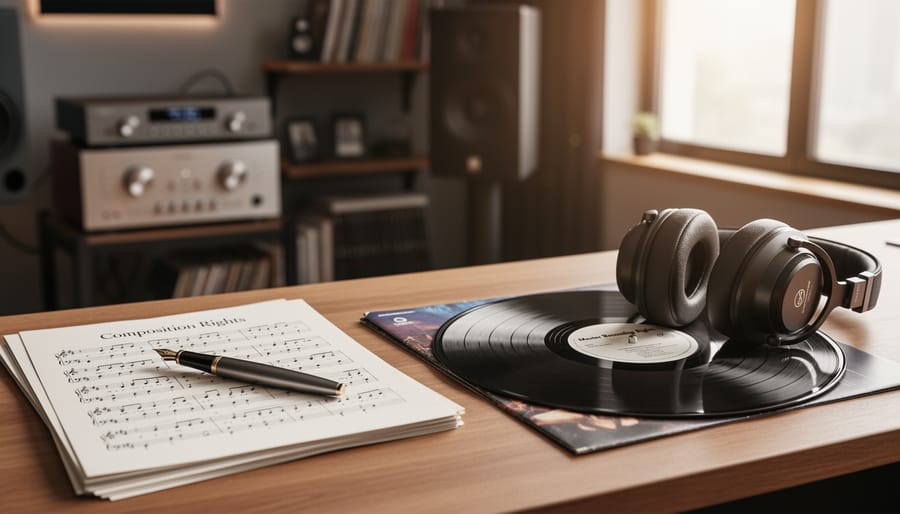
The Two Copyrights in Every Song
Every song you create involves two distinct copyrights that function independently, generate separate revenue streams, and can be owned by different people. Understanding this split is fundamental to managing your music career and ensuring you receive all the royalties you’re entitled to.
The **musical composition** (also called the “publishing” or “song” copyright) protects the underlying creative elements: the melody, lyrics, chord progressions, and arrangement you wrote. This copyright belongs to the songwriter and composer, regardless of who performs or records the song. When a Canadian artist writes a track, they own the composition rights automatically upon creation. These rights generate performance royalties when the song is played publicly, mechanical royalties when it’s reproduced, and sync fees when it’s paired with visual media.
The **master recording** (or “sound recording” copyright) protects the specific recorded performance of that composition. This copyright belongs to whoever pays for and controls the recording session, typically a record label, though independent Canadian artists who self-produce own their masters. The master generates royalties from streaming, downloads, physical sales, and certain broadcast uses.
Here’s a concrete example: if a Vancouver indie artist writes and records a song, then a Toronto band covers it, there are now three copyrights in play. The original songwriter holds the composition rights to both versions, the Vancouver artist owns the master rights to the original recording, and the Toronto band (or their label) owns the master rights to the cover version. Each copyright earns different royalties from different sources.
Understanding composition and master rights as separate entities helps Canadian creators track revenue accurately, negotiate contracts intelligently, and avoid inadvertently signing away valuable rights.
Why Licensing Rights Matter for Your Career
Understanding music licensing rights isn’t just legal housekeeping, it’s the foundation of your financial stability as a creator. Every time someone streams your song, plays it on the radio, or uses it in a commercial, licensing rights determine whether you get paid and how much you receive. Without this knowledge, you’re leaving money on the table that rightfully belongs to you.
These rights give you leverage in negotiations. When a music supervisor wants your track for a film or a brand approaches you for an advertising campaign, understanding your rights means you can make informed decisions about pricing, usage terms, and creative control. You’ll know which rights to license and which to retain for future opportunities.
Long-term career sustainability depends on maximizing every revenue stream your music generates. A single song can earn income from multiple sources simultaneously, streaming royalties, performance royalties, sync placements, and mechanical royalties from physical sales. If you don’t understand how each right works or fail to register properly with the organizations that collect these royalties, you’ll miss substantial income over your career’s lifetime.
Control matters too. Licensing rights determine who can use your music, how they can use it, and for how long. This protects your artistic vision and ensures your work isn’t associated with causes or products that contradict your values.
The Essential Types of Music Licensing Rights
Performance Rights
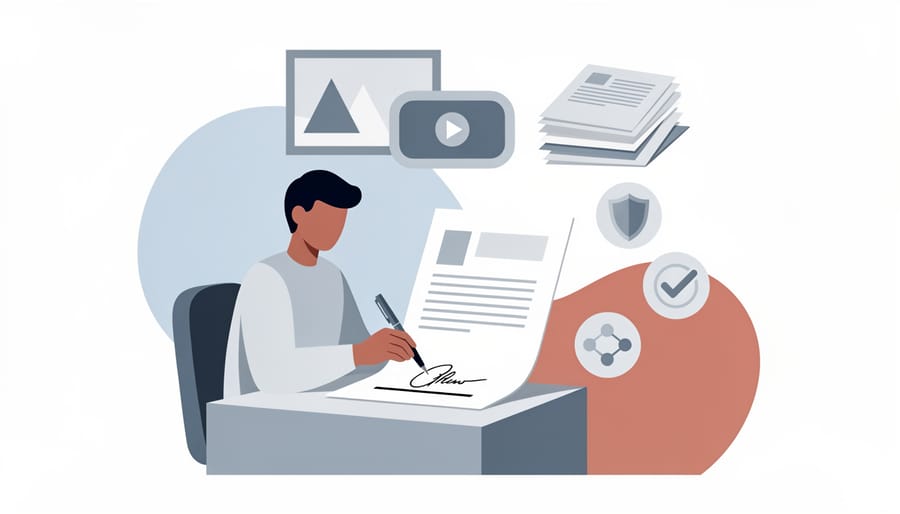
Performance rights come into play whenever your music is heard in public, whether someone plays it on the radio, streams it online, performs it at a coffee shop, or broadcasts it during a hockey game. This is separate from the right to make copies; performance rights cover the act of making your composition audible to an audience beyond private, personal use.
In Canada, songwriters and composers don’t chase down every venue or platform individually. Instead, performing rights societies handle the heavy lifting. Organizations like SOCAN (Society of Composers, Authors and Music Publishers of Canada) license your music to radio stations, streaming services, concert venues, restaurants, gyms, and anywhere else music is publicly performed. They collect fees from these users, then distribute royalties to members based on how often and where their music was played.
Streaming has reshaped performance royalties. In 2026, when a listener streams your track on Spotify or Apple Music, you earn both a mechanical royalty (for the reproduction) and a performance royalty (for the public transmission). The performance portion flows through your PRO, not directly from the platform. This dual-royalty structure means registering with a performing rights society is essential, otherwise, you forfeit half your streaming income before you even see it.

Mechanical Rights
Mechanical rights govern the reproduction of your musical composition whenever it’s copied or distributed, whether on vinyl, CD, or digital formats. Every time someone manufactures a physical copy of your song or distributes it through a streaming service, mechanical royalties are owed to you as the songwriter or composer. In Canada, organizations like SOCAN handle mechanical reproduction rights collection, ensuring you receive payment when your composition is reproduced.
In 2026, streaming platforms generate the majority of mechanical royalties for most Canadian songwriters. Unlike physical sales where the royalty is paid per unit manufactured, streaming mechanical royalties are calculated based on the number of streams your composition receives. The rates vary by platform and are often negotiated between streaming services and rights organizations representing songwriters.
Understanding mechanical rights is critical because these royalties flow separately from performance royalties. Even though a single stream triggers both, the payment comes through different channels. If you’ve written a song that another artist records, you’ll earn mechanical royalties from their version in addition to any performance royalties generated when it’s played publicly.
Synchronization Rights
Synchronization rights grant permission to pair your music with visual media, film scenes, television programs, commercials, video games, and online videos. When a production company wants to use your song in their project, they need both a sync license for the composition and a master use license for the specific recording. These licenses are negotiated individually, with fees varying dramatically based on the production’s budget, the prominence of the placement, and the media outlet’s reach.
For Canadian creators, sync licensing represents a substantial revenue opportunity in 2026. A single commercial placement can generate more income than months of streaming royalties, while film and television placements provide both payment and valuable exposure. Video game soundtracks offer another growing avenue, often requiring longer-term licenses as games remain in distribution for years.
Unlike performance or mechanical rights, sync deals are direct negotiations between rights holders and licensees, no collective societies handle these transactions. You maintain full control over which projects can use your music and at what price. Independent artists who own both their composition and master rights have a distinct advantage, as they can approve sync deals without coordinating with labels or publishers.
Print Rights and Digital Sheet Music
Print rights govern the reproduction and distribution of musical compositions as sheet music, whether in traditional printed form or digital formats. While less visible than performance or streaming royalties, these rights generate meaningful income for composers whose works are frequently performed by students, choirs, bands, and orchestras.
In 2026, digital sheet music platforms have expanded this market significantly. Services like MuseScore, Sheet Music Plus, and JW Pepper distribute arrangements and scores globally, creating passive revenue streams for composers. Canadian songwriters benefit when educators, performers, and hobbyists purchase licensed copies of their compositions.
Print rights are typically administered through music publishers or specialized print rights organizations. Composers should understand that unauthorized photocopying or digital sharing of sheet music constitutes copyright infringement, just as illegal downloads do. Licensing these rights properly ensures you receive compensation whenever your compositions are legally reproduced for performance or study.
Master Use Rights
Master use rights govern who controls the actual sound recording of a song, the specific performance captured in the studio or on stage. Unlike composition rights, which protect the underlying musical work, master use rights belong to whoever funded and produced the recording. In traditional deals, record labels own these rights and license them for use in films, commercials, or compilations. However, the landscape has shifted dramatically for Canadian independent artists in 2026. Musicians who self-release through platforms like DistroKid or TuneCore retain their master rights, giving them complete control over how their recordings are used and the ability to negotiate directly with music supervisors, brands, and filmmakers. This ownership means you collect 100% of master use fees when your recording appears in visual media, rather than splitting them with a label. The trade-off is that you shoulder all production costs and licensing administration, but for many Canadian creators, this level of control over their recorded work has become essential to building sustainable income streams.
How Canadian Musicians Protect and License Their Rights
Registering Your Work with Copyright Authorities
In Canada, your original music is automatically protected by copyright the moment you create and fix it in a tangible form, whether that’s a recording, written notation, or digital file. However, formal registration with the Canadian Intellectual Property Office (CIPO) provides crucial legal advantages that automatic protection alone cannot offer.
Registering your work creates an official public record with a precise date, which becomes invaluable if you ever need to prove ownership in a dispute. Courts give registered works stronger presumption of validity, and registration allows you to claim statutory damages in infringement cases rather than proving actual financial harm, a significant benefit when unauthorized use occurs.
The registration process is straightforward. Visit CIPO’s online portal, complete the application form with details about your composition and recording, and pay the modest fee (currently around $50 per work). You’ll receive a registration certificate that serves as legal evidence of your ownership and the creation date.
For Canadian creators building sustainable careers, registration isn’t mandatory but it’s strategic insurance. It costs little, takes minutes, and dramatically strengthens your legal position should conflicts arise over your music licensing rights down the road.
Joining Performing Rights Organizations
Canadian performing rights organizations serve as the essential infrastructure between your music and the performance royalties you’re owed. When you join a PRO, you authorize them to license your compositions for public performance, monitor where your music is played, and collect the royalties on your behalf, both within Canada and through reciprocal agreements with PROs worldwide.
Canada has two primary PROs: SOCAN (Society of Composers, Authors and Music Publishers of Canada) handles English and French-language works, while SODRAC (Society for Reproduction Rights of Authors, Composers and Publishers in Canada) manages certain reproduction rights alongside performance rights in specific contexts. Most Canadian songwriters and composers join SOCAN as their performing rights organization.
Membership is straightforward and generally free for creators. You’ll need to provide basic information about yourself, your catalogue, and your publishing arrangements. Once registered, you must submit your works to the PRO’s database with accurate metadata, title, writers, publishers, percentages. This step is critical: if your song isn’t registered with proper details, the PRO cannot match performances to your account, and you won’t receive royalties.
SOCAN monitors performances across radio, television, streaming platforms, concerts, bars, restaurants, and other venues. They distribute collected royalties quarterly based on usage data. Through international agreements with over 175 PROs globally, SOCAN ensures you receive performance royalties when your music is played in other countries, royalties that would otherwise be impossible to track and collect independently.
Understanding Reproduction Rights Societies
Reproduction rights societies collect and distribute mechanical royalties when your music is reproduced, whether on CDs, vinyl, downloads, or streaming platforms. In Canada, the Music Publishers Canada (formerly CMRRA) administers mechanical rights for most recorded music.
Here’s how the system works: When a streaming service or record label reproduces your composition, they’re required to pay mechanical royalties. Reproduction rights societies license these uses, collect the payments, and distribute them to registered songwriters and publishers. Without joining these organizations, you’ll miss a significant revenue stream.
The process differs from performance rights. While SOCAN handles royalties when your song is played publicly, reproduction rights societies manage compensation for copies made. Streaming complicates this because each stream involves both a performance (SOCAN) and a reproduction (mechanical rights society).
For Canadian creators, registering your compositions with the appropriate mechanical rights organization ensures you’re paid when digital services reproduce your work globally. Many international uses flow through partnerships between Canadian societies and foreign counterparts, making registration essential for capturing worldwide mechanical royalties from your music.
Common Licensing Scenarios Canadian Artists Encounter
Streaming Platforms and Digital Services
When you upload your music to Spotify, Apple Music, or other streaming platforms, you’re not simply making it available, you’re triggering a complex licensing process that generates two distinct revenue streams. Each stream produces mechanical royalties for the composition (paid to songwriters and publishers) and performance royalties for the public performance of that composition. If you own your master recording, you’ll also receive the recording owner’s share, typically the largest portion of streaming revenue.
Most independent Canadian artists use digital distributors like DistroKid, CD Baby, or TuneCore to deliver their music to platforms. These distributors collect and pay out the master recording revenue, but they don’t always handle all your composition royalties. Performance royalties flow through your PRO membership, while mechanical royalties from streams often require registration with additional organizations to capture fully.
The challenge in 2026 is ensuring you’re collecting from every source. Missing registrations mean leaving money on the table, streaming generates micro-payments per play, but those add up significantly across millions of streams and multiple territories when properly claimed.
Cover Songs and Sampling
When another artist wants to record your song, they need a mechanical license for the composition, but not your permission. In Canada, this falls under compulsory licensing: they must notify you (or your publisher), pay the statutory rate set by the Copyright Board, and credit you properly. Services like Easy Song Licensing handle this process, ensuring you receive mechanical royalties while the covering artist gains legal clearance.
Sampling is entirely different. If someone wants to use even a short snippet of your master recording or composition, they need explicit permission from both the sound recording owner and the composition rights holder. There’s no compulsory license for samples. Unauthorized use opens the door to copyright infringement claims, potentially forcing the sampler to remove the track or share royalties retroactively.
As a Canadian creator, register both your compositions and masters to ensure you’re contacted when others want to use your work, and always clear samples before releasing anything that incorporates someone else’s music.
International Use and Cross-Border Licensing
When your music crosses borders, whether through streaming platforms, international broadcasts, film placements, or physical sales, you’re entitled to royalties from those uses. Canadian creators collect these international revenues through reciprocal agreements between Canadian rights organizations and their foreign counterparts.
SOCAN maintains agreements with performing rights organizations in over 160 countries, ensuring that when your song plays on radio in Germany or streams in Japan, the local PRO collects royalties and forwards them to SOCAN for distribution to you. Similarly, CMRRA and Connect Music Licensing work with mechanical rights societies worldwide to track reproduction royalties from international markets.
The challenge lies in registration completeness. If your music isn’t properly registered with Canadian organizations, or if metadata is incomplete or inconsistent across platforms, international royalties may go uncollected. Some territories also have different payment timelines, European royalties often take 18 to 24 months to reach Canadian creators.
For direct licensing opportunities like sync placements in foreign productions, you’ll typically negotiate fees upfront while retaining performance rights that generate ongoing royalties when the content airs internationally.
Avoiding Common Music Licensing Mistakes
Not Registering Your Music Properly
Incomplete or missing registration creates gaps in your royalty collection that can cost you thousands of dollars over time. When you fail to register your compositions with performing rights organizations or reproduction rights societies, these organizations cannot identify your work when it’s used, meaning royalties go uncollected or end up in general funds. The same applies to copyright registration, without formal documentation, proving ownership becomes significantly harder if disputes arise.
Many Canadian musicians register with one organization but neglect others, leaving entire revenue streams untapped. For example, registering only with SOCAN captures performance royalties but misses mechanical royalties that flow through other channels. Similarly, failing to update registrations after collaborations or ownership changes leads to incorrect splits and payment delays.
The solution is systematic: register every new work promptly with all relevant organizations, maintain accurate metadata including songwriter and publisher information, and keep your contact details current so payments reach you without interruption.
Signing Away Rights Without Understanding the Terms
Contracts in the music industry often contain clauses that permanently transfer rights you assume you’re only licensing temporarily. Recording agreements, publishing deals, and even collaboration agreements may include language granting another party ownership of your master recordings or compositions, not just the right to use them. Once you sign, reclaiming those rights can be legally impossible or prohibitively expensive.
The consequences extend beyond lost revenue. You might forfeit creative control over how your work is used, where it appears, or whether it can be altered. Some agreements include “work for hire” provisions that designate the commissioning party as the legal author, erasing your copyright claim entirely.
Before signing any contract involving your music, consult an entertainment lawyer familiar with Canadian copyright law. Legal review costs far less than the income and control you risk losing. Ask specific questions: Am I transferring ownership or granting a license? What rights am I retaining? Can I terminate this agreement, and under what conditions? Understanding the terms protects both your current work and your future catalog.
Assuming All Royalties Come Automatically
Many musicians believe that once they release a song, royalties will simply appear in their bank account whenever their music gets used. This dangerous assumption costs Canadian creators thousands of dollars annually in uncollected revenue.
The reality is starkly different. Royalties flow through separate channels, performance rights organizations handle radio and streaming plays, mechanical rights societies collect reproduction fees, and sync licensing requires direct negotiation. None of these systems communicate automatically. If you haven’t registered your work with each relevant organization, those royalties never reach you. They sit in holding accounts, sometimes redistributed to registered members or eventually written off.
Active management means verifying your registrations annually, tracking where your music appears, and claiming royalties from international uses. It requires monitoring streaming platforms, checking with PROs about unmatched works, and following up on licensing opportunities. Canadian creators who treat rights management as an ongoing responsibility, not a one-time task, consistently earn 30-50% more from the same catalogue than those who set and forget.
The Future of Music Licensing Rights in Canada
The music licensing landscape is shifting faster than ever, driven by advances in technology, evolving consumer habits, and ongoing legislative reforms. Canadian creators who understand these changes, and adapt proactively, will be best positioned to protect their rights and maximize their income in the years ahead.
**Artificial Intelligence and Automated Licensing**
AI-generated music and automated licensing platforms are already changing how rights are tracked and monetized. In 2026, blockchain-based systems and smart contracts are gaining traction as tools for transparent, instant royalty distribution. While these technologies promise efficiency, they also raise questions about how rights are attributed when AI contributes to composition or production. Canadian creators should monitor how organizations like SOCAN integrate these tools and ensure that automation doesn’t obscure their entitlement to fair compensation.
**Legislative Updates and Fair Compensation Advocacy**
The Canadian government continues to review copyright legislation in response to digital distribution realities. Recent consultations have focused on ensuring streaming platforms pay equitable rates and that creators receive a larger share of digital revenue. Advocacy groups representing musicians and songwriters are pushing for reforms that close loopholes and strengthen enforcement mechanisms. Staying engaged with these policy discussions, through industry associations and creator coalitions, gives you a voice in shaping the rules that govern your career.
**Global Licensing and Cross-Border Complexity**
As Canadian music reaches international audiences through streaming and social media, cross-border licensing becomes more complex. Agreements between Canadian PROs and foreign collection societies are expanding, but gaps remain in certain territories. Creators working with international collaborators or audiences should verify that their rights are protected globally, not just domestically, and consider registering with multiple organizations to capture revenue from all markets.
The future rewards creators who stay informed, embrace new tools, and advocate for fair treatment. By understanding how technology and policy intersect, you can turn industry shifts into career advantages rather than obstacles.
Understanding music licensing rights isn’t just a legal formality, it’s the foundation of building a sustainable career in music. Every song you create represents multiple streams of potential revenue, but only if you actively protect and manage those rights. Canadian musicians and songwriters who take the time to register their work, join the appropriate rights organizations, and understand the licensing landscape position themselves to receive fair compensation for their creativity.
The music industry continues to evolve rapidly, with new platforms and revenue opportunities emerging alongside persistent challenges. What remains constant is this fundamental truth: your rights are your most valuable asset. Whether you’re an independent artist self-releasing music or working with labels and publishers, knowing which rights you hold and how they generate income gives you the power to make informed decisions about your career.
Too many talented Canadian creators leave money on the table simply because they don’t understand the systems designed to collect their royalties. Others unknowingly sign away rights that could have provided income for decades. These aren’t inevitable mistakes, they’re preventable through education and proactive rights management.
Moon Face is committed to supporting Canadian musicians and songwriters in navigating this complex landscape. By advocating for fair compensation, providing resources to understand your rights, and connecting Canadian creators to the broader music community, we’re working toward an industry where talent is properly valued and compensated. Your music matters. Your rights matter. Take control of both.