
The Canadian music industry is undergoing its most significant shift in rights management in decades. Reproduction and performing rights administration, long handled through separate channels and systems, is consolidating into streamlined digital platforms that promise faster, more accurate royalty distribution and stronger transparency for creators. This transformation directly affects how you register your works, track their use, and receive fair compensation.
For songwriters and music publishers, understanding this evolution isn’t optional. The digitization of music consumption has outpaced the administrative infrastructure that was built for physical sales and broadcast radio. Streaming platforms, user-generated content, and cross-border distribution have created a maze of micro-royalties that older systems struggle to capture. The modernized approach addresses these gaps by integrating data sources, automating matching processes, and creating unified portals where creators can manage both reproduction rights (the right to copy and distribute) and performing rights (the right to publicly perform or broadcast) in one place.
This shift brings practical questions: Who qualifies to participate? How do you transition your existing catalog? What new responsibilities do you take on? And where do you turn when something doesn’t work as expected? The answers matter because incomplete or incorrect registration means lost revenue. The following guide walks you through eligibility, registration steps, your rights and obligations under the new framework, and the support resources available to ensure you capture every dollar your music earns.
What Transforming Reproduction and Performing Rights Means

Reproduction Rights in the Digital Era
Reproduction rights once meant controlling physical copies, vinyl, CDs, cassettes. Now they govern every digital instance of your work. When a listener streams your song on Spotify, downloads it from Apple Music, or a filmmaker uses it in a YouTube video, reproduction rights apply. The Canadian Copyright Act recognizes these reproductions as distinct from physical manufacturing, triggering separate licensing requirements and royalty streams.
Each platform interaction creates a reproduction event. A single stream generates a temporary copy on the user’s device; a download creates a permanent one. Synchronization, pairing your music with visual media, adds another layer, requiring creators to license audio for film, television, advertising, podcasts, and social media. Moon Face’s transformed system tracks these varied uses automatically, capturing revenue from contexts that didn’t exist when reproduction rights were first codified. Where physical sales generated one payment per unit sold, digital distribution splits reproduction royalties across mechanical rates, streaming micro-payments, and sync fees, each reflecting how listeners actually engage with music in 2026.
Performing Rights and Global Reach
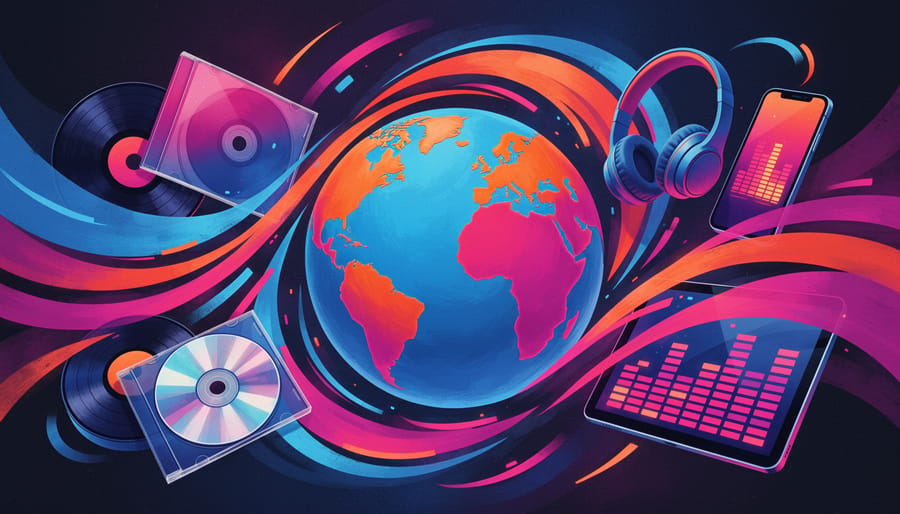
Performing rights have transformed from tracking radio airplay and concert halls to capturing every instance your music reaches listeners worldwide. When your song plays on Spotify in Sweden, at a music festivals in Montreal, or during a livestream watched across three continents, you’re entitled to compensation, but only if the performing rights infrastructure can track and collect across borders.
The modernized system connects Canadian rights organizations directly with international collection societies through reciprocal agreements and real-time data sharing. This means performances on platforms like Apple Music, YouTube, and TikTok generate royalties regardless of where listeners are located. Cross-border live performances, previously difficult to track and monetize, now trigger payment flows through interconnected databases that recognize your works instantly.
For international broadcasts, the transformation addresses a longstanding gap: Canadian music played on foreign radio stations, television programs, or digital channels now feeds data back to Moon Face through standardized reporting protocols. You no longer need separate registrations in each territory. The integrated network handles identification, allocation, and distribution automatically, ensuring your performing rights income reflects your music’s true global reach.
Who Qualifies for Transformed Rights Management
Canadian Creators and Rights Holders
Canadian creators with professional or commercial music activity qualify for the transformed reproduction and performing rights system. If you write, compose, publish, or record music intended for distribution, whether through streaming platforms, physical sales, broadcasts, or live performances, you meet the basic threshold for participation.
Professional musicians, songwriters, composers, lyricists, and music publishers operating from a Canadian base are eligible regardless of genre, distribution scale, or career stage. The system recognizes both established artists with extensive catalogues and emerging creators releasing their first works. Independent artists self-releasing music qualify on the same terms as those signed to labels or publishing agreements.
Canadian residency or a registered Canadian business presence establishes your eligibility pathway. You need verifiable Canadian tax status or a Canadian business registration number, which connects your creator identity to the domestic rights framework while enabling international royalty collection through reciprocal agreements.
Co-writers and collaborators on joint works each register their respective shares independently. If you contribute to a composition or recording with other creators, you register your percentage of ownership, the system tracks split percentages across multiple rights holders for the same work. Understanding who qualifies for specific rights categories helps you determine whether you need separate registrations for reproduction rights, performing rights, or both.
International Artists with Canadian Connections
International creators qualify for transformed rights protection when they maintain substantive Canadian connections through distribution, collaboration, or performance activities. The modernized system recognizes that music crosses borders, and Canadian platforms, labels, or distributors often amplify international work.
You qualify if your recordings receive distribution through Canadian services, whether physical retail, digital platforms headquartered in Canada, or licensing deals with Canadian labels. Collaborations with Canadian co-writers, producers, or featured artists establish eligibility, as these partnerships generate rights that the system must track and compensate fairly.
Live or broadcast performances in Canada trigger performing rights coverage. If you’ve toured Canadian venues, appeared on Canadian radio or television, or streamed performances to Canadian audiences, those activities create rights the transformed system protects.
Registration requires documentation proving your Canadian connection: distribution agreements, collaboration contracts, performance receipts, or streaming data showing Canadian audience engagement. The system doesn’t demand Canadian residency, but it does verify genuine activity rather than nominal presence.
International creators should designate a Canadian representative, typically your distributor, label, or rights administrator, to handle communications and payments, ensuring smooth coordination across jurisdictions.
How to Register and Activate Your Transformed Rights
Initial Registration and Profile Setup
Creating your Moon Face account starts with the online registration portal at . You’ll need a valid email address, government-issued photo ID, and proof of creator status, either a published recording, registered composition, or documentation of a public performance within the past three years. The identity verification process typically takes 24 to 48 hours and uses secure document scanning to confirm your credentials.
Once verified, you’ll build your creator profile by selecting your primary roles (songwriter, composer, performer, or publisher), specifying your Canadian residency status or international connection, and indicating which types of rights you control. This profile determines how the system routes your royalties and applies relevant transparency principles to your account reporting. Accurate profile setup ensures you receive all entitled streams from day one, incomplete profiles can delay payments by months, so invest the fifteen minutes to complete every required field before moving to catalog registration.
Cataloguing Your Works
Proper cataloguing creates the foundation for collecting every royalty stream you’ve earned. Start by gathering complete metadata for each work: composition title, all co-writers and their ownership splits, ISWC if available, and creation date. For recordings, you’ll need the ISRC code, recording date, all performers, and label information if applicable.
Upload works individually or use bulk import templates for extensive catalogues. The system requires precise ownership percentages, if you co-wrote a song with two others equally, enter 33.33% for each writer. Vague or missing splits delay payments.
Link recordings to their underlying compositions to capture both mechanical and performance royalties. A single song might have multiple recordings by different artists; register each version separately while connecting them to the original composition.
For live performances, log venue details, setlists, and dates when possible. This data supports performance royalty claims, particularly for international broadcasts or streamed concerts. Update your catalogue within thirty days of releasing new work to avoid retroactive payment gaps.
Activating International Royalty Collection
Enabling international royalty collection ensures you capture earnings from platforms and performances outside Canada. Once your works are catalogued, connect your account to reciprocal collection societies in target markets, Europe, the United States, Asia, and Australia operate regional agreements that funnel royalties back through Moon Face. Navigate to “International Rights” in your dashboard, select territories where your music streams or performs, and authorize data sharing with partner organizations. This triggers automatic registration with societies like ASCAP, PRS for Music, or APRA AMCOS without requiring separate applications.
Cross-border activation typically processes within four to six weeks. During this period, Moon Face synchronizes your catalog with international databases, matching your works to foreign plays and streams. Review the confirmation report to verify all compositions and recordings appear correctly in each territory. Discrepancies, misspelled titles, incorrect publisher credits, delay payments, so flag errors immediately through the support portal. Once active, international royalties flow quarterly through a single consolidated statement, eliminating the need to navigate multiple foreign organizations or currency conversions independently.
Your Rights and Obligations Under the Transformed System
What You’re Entitled to Receive
Under the transformed rights system, you’re entitled to multiple royalty streams that reflect how your music is actually used. Reproduction royalties cover mechanical uses, streaming, downloads, and physical sales, while performing royalties capture radio play, live performances, and background music in commercial spaces. Both streams now operate through unified reporting, so you see exactly where your earnings originate.
Payments arrive quarterly through direct deposit, typically 90 days after the collection period ends. You’ll receive detailed statements breaking down each use by platform, territory, and work, replacing the vague summaries that plagued older systems.
Transparency is built into the framework. Your online dashboard updates monthly with preliminary data, showing which songs are generating activity and where. You can drill down to individual plays, matching what platforms report against what you receive.
You also hold audit rights. If royalty statements seem incomplete or inaccurate, you can request a formal review of the data underlying your payments. Moon Face must respond within 30 days and provide documentation supporting their calculations. This safeguard ensures accountability and gives you leverage if discrepancies surface.
Your Responsibilities as a Rights Holder
Once you’re enrolled in the transformed rights system, maintaining accurate records becomes your core responsibility. Keep your catalog current by reporting new releases within 30 days of distribution, delays can result in missed royalties during the gap period before your work enters the system.
Document all collaborations in writing. When you co-write, co-produce, or share publishing, register each contributor’s percentage splits before releasing the work. Disputes over undocumented splits freeze payments for everyone involved until resolved, so clarity upfront protects all parties.
Update your contact and banking information immediately when changes occur. Payment processing runs on fixed schedules; outdated details mean your royalties go into holding accounts rather than your hands, and retrieval adds months to your wait.
Report changes in ownership, publisher assignments, or territorial restrictions within 60 days. The system distributes royalties based on the data you provide, if your records don’t reflect current reality, you’re directing money to the wrong places or leaving it unclaimed.
Failed audits due to poor documentation can trigger payment holds. Keep contracts, registration confirmations, and correspondence for seven years minimum. Your diligence directly determines whether royalties flow smoothly or stall in administrative limbo.
Where to Get Help and Support

Moon Face Creator Support Services
Moon Face maintains a dedicated creator support team specifically trained in the transformed rights framework. Registered creators access personalized assistance through three primary channels: a secure online portal with ticketing system for documentation-heavy inquiries, a direct phone line (1-800-MOONFACE) operating weekdays 9am-5pm ET for urgent questions, and monthly virtual office hours where rights specialists address complex scenarios in small group sessions.
The support infrastructure includes a comprehensive knowledge base with video tutorials covering registration workflows, catalog management, and international royalty activation. New registrants receive a welcome packet with customized guidance based on their creator type, solo musicians, songwriters, bands, or publishers, plus access to quarterly webinars explaining payment statements and rights maximization strategies.
For intricate situations involving multiple co-writers, cross-border collaborations, or historical catalog transfers, creators can book complimentary 45-minute consultations with rights advisors who review specific circumstances and recommend optimal setup configurations. The team also offers expedited registration review for time-sensitive releases or distribution deadlines, typically completing verification within three business days instead of the standard ten.
Partner Organizations and International Connections
Accessing comprehensive rights support often requires coordination across multiple organizations. Moon Face maintains formal partnerships with collection societies in over 40 countries, enabling creators to resolve international rights questions through a single point of contact rather than navigating foreign bureaucracies independently.
The Canadian Musical Reproduction Rights Agency (CMRRA) and SOCAN serve as primary partners for reproduction and performing rights respectively, while international bodies like ASCAP, BMI, PRS for Music, and GEMA provide regional expertise. When you encounter complex cross-border situations, co-writes with international collaborators, recordings released in multiple territories, or disputed ownership claims spanning jurisdictions, Moon Face’s partnership network connects you directly with specialists who understand local licensing frameworks and can expedite resolution.
How to Apply or Complete the Process
Applying for the transformed reproduction and performing rights system follows a straightforward sequence. Begin by visiting the Moon Face creator portal and selecting “Register for Transformed Rights Management.” You’ll create an account using your professional email address and verify your identity through government-issued ID or existing collective management organization credentials.
Once logged in, complete your creator profile by providing your legal name, professional pseudonyms, contact information, and residency status. Canadian creators need to confirm their residency and provide a Social Insurance Number for tax reporting. International creators should specify their primary country of residence and any Canadian distribution agreements or collaborations.
Next, submit your work catalog. Upload track metadata, ISRC codes where available, and documentation of co-authorship or publishing splits. For works already registered with other collection societies, provide membership numbers to enable reciprocal agreements.
The final step activates your royalty collection preferences: select payment frequency, choose your preferred currency, and provide banking details for direct deposit. Verification typically takes five to seven business days. You’ll receive confirmation when your account is active and eligible for royalty distributions under the modernized system.
Common Questions About Transformed Rights
The shift to transformed reproduction and performing rights raises practical questions for creators navigating the new system. Here are answers to the most common concerns.
Do I need to re-register existing works?
No. Works already registered with Moon Face or partner collection societies automatically transfer to the transformed system, though you should verify your catalog is complete and accurate.
How does this affect my current royalties?
The transformation improves payment tracking and international collection without interrupting your existing royalty streams. You may see increased payments as the system captures previously uncollected revenue, particularly from streaming and cross-border performances.
What happens to my international earnings?
The transformed system strengthens international collection through enhanced partnerships with global collection societies, meaning you should receive more comprehensive reporting and payments from overseas use of your works.
How long does activation take?
New registrations typically activate within 10 business days, while catalog transfers and international connection setup may take 30 to 45 days depending on the complexity of your rights portfolio.
If you registered works through multiple organizations in the past, the transformation consolidates these registrations under a unified tracking system. This eliminates duplicate administration and ensures you receive all entitled royalties through a single, transparent reporting process. Creators with complex rights situations, such as co-written works, multiple publishers, or historical catalog transfers, can request a catalog audit through Moon Face’s support services to confirm everything is properly tracked. The transformation handles these complexities automatically once your complete catalog information is verified.