
Canadian performers earn neighbouring rights royalties when their recorded performances are broadcast or publicly performed. If you’ve recorded music as a featured or session musician, you’re entitled to collect these payments through two Canadian collectives: Re:Sound and ACTRA RACS (Recording Artists’ Collecting Society). Registration is free, and once you’re enrolled, these organizations track your airplay and performances across radio, television, streaming services, and public venues, then distribute your share of royalties.
Unlike the songwriting royalties that composers collect, neighbouring rights compensate the performers and musicians who brought those songs to life in the studio. This includes everyone from lead vocalists to background singers, instrumentalists to spoken-word artists. The payments come from broadcast tariffs and licensing fees that radio stations, streaming platforms, bars, restaurants, and other businesses pay for the right to play recorded music publicly.
Canadian performers benefit from one of the world’s strongest neighbouring rights frameworks. Your entitlement applies not only to Canadian airplay but also to international broadcasts in more than 80 countries through reciprocal agreements. Many performers leave money unclaimed simply because they don’t know these rights exist or assume registration is complicated.
The process is straightforward. You’ll need basic documentation of your recording credits, and you can register with both collectives simultaneously since they administer different revenue streams. Re:Sound handles most Canadian broadcast and public performance royalties, while ACTRA RACS focuses on international collection and specific Canadian uses. Together, they ensure you capture the full spectrum of what you’ve earned.
This guide walks you through eligibility requirements, step-by-step registration with each collective, what rights and obligations come with membership, how payments work, and where to get support when questions arise.
What Are Neighbouring Rights Royalties?
Neighbouring rights royalties compensate performers and musicians for the public use of their recorded performances. When a recording is broadcast on radio, played in a restaurant, streamed on a digital platform, or performed publicly, the performers on that recording are entitled to payment separate from the songwriters and publishers who own the composition. This distinct revenue stream recognizes that creating a commercially released recording involves both creative and interpretive labour, and Canadian law protects performers’ right to share in the value their work generates.
The legal foundation for neighbouring rights in Canada rests on Part II of the Copyright Act, which grants performers Certain rights and interests protected when their performances are fixed in sound recordings and used publicly. This framework extends beyond featured artists to session musicians, background vocalists, and anyone whose performance appears on a commercial release. Internationally, the Rome Convention and the WIPO Performances and Phonograms Treaty establish reciprocal protections, allowing Canadian performers to collect royalties when their recordings are played abroad and ensuring foreign performers working in Canada receive fair compensation.
Neighbouring rights differ fundamentally from mechanical and performance royalties, which flow to songwriters and publishers. Mechanical royalties pay songwriters when a composition is reproduced or distributed; performance royalties compensate them when the composition is performed publicly or broadcast. Neighbouring rights, by contrast, reward the performer’s contribution to the recorded version of that composition. A session guitarist who didn’t write the song still earns neighbouring rights when the track is played on CBC Radio; the songwriter collects performance royalties through SOCAN, while the guitarist collects neighbouring rights through Re:Sound. This parallel system ensures both creators and performers benefit when recorded music reaches audiences.
Implementing transparency principles in neighbouring rights collection means performers can track where their recordings are played, verify royalty calculations, and confirm they receive their entitled share. Collective management organizations monitor broadcasts, digital streams, and public performances, then distribute pooled royalties to registered performers based on documented credits. Without registration, performers forfeit these payments entirely, leaving money that belongs to them uncollected and redistributed to others.
Who Is Eligible to Collect Neighbouring Rights Royalties in Canada?
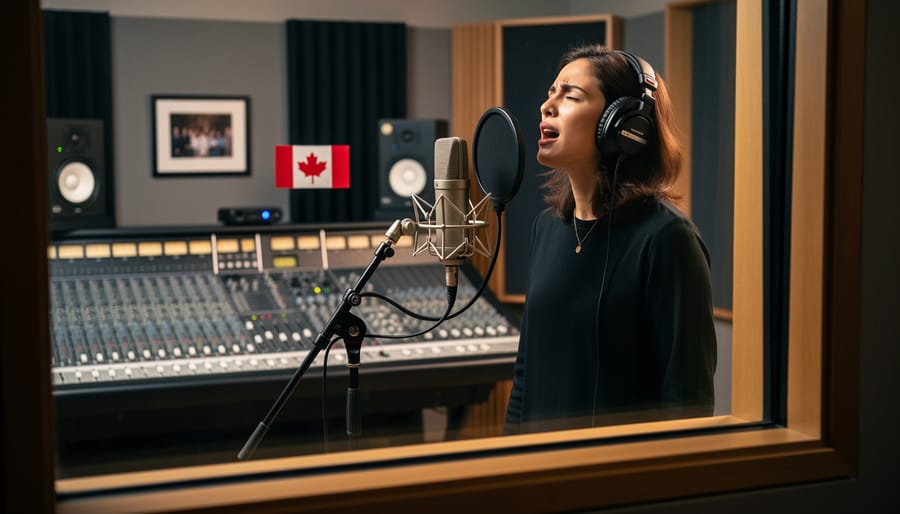
Canadian Citizenship and Residency Criteria
To collect neighbouring rights royalties in Canada, you must meet one of three residency criteria. Canadian citizens qualify automatically, regardless of where they currently live or work. Permanent residents of Canada also have full rights eligibility provided their status remains valid at the time of registration.
Work permit holders face stricter conditions. If you’re working in Canada on a temporary permit, you can register and collect royalties only for performances recorded during the period your permit was active. You’ll need to provide proof of your work authorization alongside your performance documentation. Once your permit expires, you lose eligibility for future royalties unless you obtain permanent residency or citizenship.
Re:Sound and ACTRA RACS verify residency status during registration and may request updated documentation if your status changes. Keep copies of your citizenship certificate, permanent resident card, or work permit readily available. If you held multiple immigration statuses over your career, track which recordings were made under each, as this determines which performances qualify for Canadian royalty collection.
International Performers and Reciprocal Agreements
Canada’s neighbouring rights system extends beyond national borders through reciprocal agreements with over 60 countries. When Canadian performers’ recordings are broadcast or played publicly in participating nations, including the United States, United Kingdom, European Union countries, Australia, and Japan, local collectives collect royalties on their behalf and transfer them to Re:Sound or ACTRA RACS for distribution.
The reciprocity works both ways. Foreign performers whose recordings receive airplay in Canada earn neighbouring rights royalties here, even without Canadian citizenship. However, the performer’s home country must have a reciprocal agreement with Canada and recognize neighbouring rights in its own copyright law. Notably, the U.S. lacks full reciprocity because it doesn’t grant neighbouring rights for terrestrial radio broadcasts domestically, limiting what American performers can collect from Canadian airplay.
Canadian performers working internationally should register with both Canadian collectives and foreign societies in countries where their music receives significant exposure. Many performers maintain memberships in multiple territories to maximize collections, though most collectives coordinate through reciprocal arrangements to avoid double-claiming. Check Re:Sound’s list of partner societies to confirm coverage in specific markets before assuming automatic international collection.
How to Register and Collect Your Neighbouring Rights Royalties

Registering with Re:Sound
Creating your Re:Sound account starts at, where you’ll click “Register” and choose whether you’re signing up as a featured artist, session musician, or both. The online form asks for basic personal information, name, date of birth, address, social insurance number, and your preferred payment method. You’ll need a valid Canadian SIN or business number; without it, Re:Sound can’t distribute royalties to you.
Once logged in, head to the “Add Recordings” section. Here you’ll upload your discography by searching Re:Sound’s database for existing releases or manually entering new ones. For each recording, specify your role: lead vocalist, instrumentalist, backing singer, or other contributor. Be precise, Re:Sound uses these credits to calculate your share of the royalty pool. If you played on an album but aren’t listed in liner notes, upload supporting documentation: studio contracts, emails from producers, or AFM session logs.
Verifying session work takes longer than featured artist claims. Re:Sound may reach out to labels, producers, or other credited performers to confirm your involvement. Submit whatever proof you have upfront to speed this along. Scanned contracts and dated studio schedules carry more weight than memory.
For payment setup, link your bank account through the secure portal. Re:Sound distributes royalties twice yearly, typically in June and December. Direct deposit ensures you receive funds without delay; cheques can take weeks and sometimes get lost in the mail.
Registering with ACTRA RACS
ACTRA RACS (Recording Artists’ Collecting Society) serves Canadian performers who have contributed to sound recordings used in film, television, commercials, and other audiovisual productions. Unlike Re:Sound, which focuses on audio broadcasts and public performances, ACTRA RACS collects royalties specifically when your recorded performances appear in visual media.
You don’t need to be an ACTRA union member to register with ACTRA RACS. The organization accepts both union and non-union performers, though ACTRA members may access additional advocacy resources. Registration requires basic performer information, details about your audiovisual recording credits (including film soundtracks, TV show music, commercial jingles, and documentary scores), and banking information for direct deposit.
ACTRA RACS complements your Re:Sound registration rather than replacing it. Most Canadian performers should register with both organizations to capture the full spectrum of neighbouring rights royalties. Re:Sound handles audio-only uses like radio play and streaming, while ACTRA RACS covers synchronization uses where your performance appears alongside video. Together, they ensure you’re compensated whenever your recorded work reaches audiences through broadcast, streaming platforms, or public venues.
The registration process mirrors Re:Sound’s system: create an account online, upload your performance credits with as much detail as possible, and keep your profile current as you add new projects.
Documentation and Proof of Performance
When you register with Re:Sound or ACTRA RACS, you need documentation proving your performance on each recording. The most reliable evidence includes written contracts, recording agreements, studio invoices listing your name, and signed session call sheets. If you’re credited in liner notes, album booklets, or digital metadata on streaming platforms, screenshot or save those credits, they carry weight when verifying your contribution.
For older recordings where formal paperwork doesn’t exist, gather whatever you can: emails from producers or labels confirming your participation, payment receipts showing your fee for the session, photographs from the recording date, or written statements from the primary artist or producer. If you’re uncredited on a release but you know you performed, contact the label or producer directly and ask for a letter confirming your role. Re:Sound and ACTRA RACS accept statutory declarations, sworn statements attesting to your performance, when no other proof is available, though they may require corroborating evidence from a second party.
Maintain organized records for every session moving forward. Create a simple spreadsheet logging the date, project name, artist, studio, your role (featured artist, background vocalist, instrumentalist), and any contract or invoice reference. This habit protects your future royalty claims and eliminates the scramble to reconstruct your discography years later.
Your Rights and Obligations as a Registered Performer
Once you’ve registered with a Canadian collective, you hold specific legal rights under copyright law, and equally important responsibilities that keep your royalty stream flowing.
Your fundamental right is payment whenever your recorded performances are broadcast on radio or TV, streamed through digital services like Spotify or Apple Music in their business or public tiers, or played in commercial venues such as restaurants, retail stores, gyms, and offices. This applies to both featured performances where you’re the lead artist and non-featured work as a session musician or background vocalist. The Copyright Act guarantees these payments; they aren’t discretionary or dependent on the goodwill of users.
| Your Right | What It Means | Your Obligation |
|---|---|---|
| Right to payment | Receive royalties when your recordings are publicly performed, broadcast, or streamed | Maintain accurate registration data, report new releases promptly, keep banking information current |
| Right to audit | Request detailed royalty statements and challenge underpayment or errors | Review statements regularly, raise concerns within specified timeframes, provide supporting documentation |
| Right to international collection | Claim royalties from reciprocal territories where your work is used | Update foreign repertoire lists, verify international credits, respond to verification requests from partner collectives |
You’re also entitled to transparency. Collectives must provide periodic royalty statements showing which recordings generated payments, the sources of those payments, and how your share was calculated. If you believe you’ve been underpaid or notice discrepancies, you have the right to request detailed breakdowns and initiate formal audit & disputes processes through the collective’s internal review mechanisms.
In return, you must fulfill certain obligations. Keep your profile current: when you release new recordings, add them to your collective’s database with complete credits and metadata. If you change your legal name, band name, or banking details, notify the collective immediately, payments can’t be issued to outdated accounts. Respond promptly to verification requests, which typically ask you to confirm your participation on specific recordings or clarify conflicting credits. Ignoring these requests can delay or suspend payments.
You’re also expected to report accurately. Claiming performances you didn’t contribute to, inflating your role, or submitting fraudulent credits violates your membership agreement and can result in account suspension or legal action. Honest, complete reporting protects the integrity of the system for all performers and ensures royalties reach their rightful recipients.
How Neighbouring Rights Royalties Are Calculated and Distributed
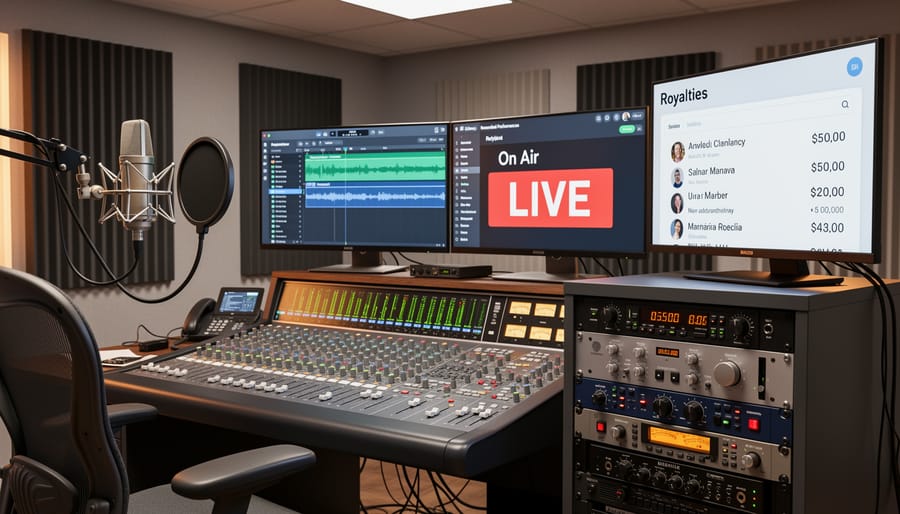
Collectives like Re:Sound monitor a wide range of public performances to build the royalty pool that supports fair compensation for Canadian performers. They track usage through broadcast logs from radio stations, digital service reports from streaming platforms, and sampling data from commercial venues. The data they gather covers:
- Radio broadcasts on commercial stations, CBC, and campus radio
- Streaming services with publicly accessible playlists
- Satellite radio channels
- Background music services in retail and hospitality
- Live venue playback of recorded music
- International broadcasts under reciprocal agreements
Once the collective tallies all reported plays, it divides the royalty pool among eligible performers based on each recording’s share of total airplay. Featured artists typically receive a larger percentage than non-featured contributors such as session musicians and background vocalists, but the exact split varies by collective and agreement. Re:Sound, for example, allocates 50% to featured performers and 50% to non-featured performers across the entire pool, then distributes each half proportionally according to play frequency and contract terms.
Payment schedules depend on reporting cycles and verification timelines. Most collectives issue distributions quarterly or semi-annually, and amounts vary widely. A performer whose recording receives heavy rotation on major stations might collect thousands of dollars per distribution, while someone with limited airplay on smaller outlets could see tens or hundreds. International plays generate additional revenue when partner collectives remit to Re:Sound or ACTRA RACS, though those payments often arrive on a different schedule and may take longer to process. Performers can view detailed statements through their online accounts, showing which recordings earned royalties, where they played, and how much each usage contributed.
Where to Get Help and Support
If you need guidance or run into obstacles during the registration process, several Canadian organizations provide direct support for performers collecting neighbouring rights royalties.
Re:Sound operates a dedicated help desk for artists navigating registration and royalty claims. Their online resource centre includes step-by-step tutorials, downloadable checklists for gathering documentation, and FAQs covering common scenarios like uncredited session work or name changes. You can reach their support team by phone or email to clarify eligibility questions, troubleshoot account issues, or verify performance credits. Re:Sound also hosts free registration workshops in major Canadian cities and online webinars that walk performers through how to apply and maintain accurate records.
ACTRA RACS provides similar support for union and non-union performers, with staff available to explain membership requirements, assist with documentation submission, and resolve payment discrepancies. Their website features practical guides on claiming royalties for older recordings and international performances.
Music Canada offers advocacy and education resources, including policy updates on neighbouring rights legislation and connections to legal clinics that specialize in copyright and entertainment law. If you face underpayment disputes or audit concerns, their directory can point you toward affordable legal assistance.
The Canadian Live Music Association hosts regional events where performers can meet directly with collective representatives, ask questions, and complete registration onsite.
For complex disputes or contractual issues, consider reaching out to provincial law societies that maintain referral services for entertainment lawyers. Many offer initial consultations at reduced rates or pro bono clinics for emerging artists.
How to Apply or Complete the Process

To begin collecting neighbouring rights royalties, start by gathering your documentation: recording credits, liner notes, contracts, and release information for all projects where you performed. This proof establishes your claim to royalties.
Next, visit the Re:Sound website and create an account. You’ll complete an online registration form with your personal details, banking information for direct deposit, and citizenship or residency status. Upload your discography, listing each recording where you appear as a featured artist, session musician, or background vocalist. Be thorough, incomplete credits mean missed payments.
If you’re an ACTRA member or work in broadcast recordings, register separately with ACTRA RACS. Their registration process mirrors Re:Sound’s but focuses on union-covered work and broadcast performances.
After submitting your registration, both organizations will verify your claims against their databases and industry records. This verification typically takes four to eight weeks. You may receive requests for additional documentation if credits are unclear or missing from standard sources.
Once approved, you’ll receive confirmation and begin appearing in royalty distributions. Most collectives pay quarterly or semi-annually. Update your profile immediately whenever you release new recordings, change your legal name, or update banking details to avoid payment delays.
Frequently Asked Questions About Neighbouring Rights Royalties
How long does the registration process take?
Once you submit your registration to Re:Sound or ACTRA RACS, account approval typically takes two to four weeks. Verification of specific recordings and credits can add another few weeks, especially for older releases or session work that requires documentation.
Can I claim royalties for past performances?
Yes, but there are limitations. Re:Sound distributes royalties collected in recent years, so registering now means you’ll receive payments for plays that occurred after their most recent distribution cutoff, plus any future plays. However, royalties collected before your registration may not be recoverable if the statutory holding period has expired.
What if I’m not credited on a recording?
You can still claim neighbouring rights if you can prove your performance. Gather any documentation you have, contracts, studio logs, call sheets, correspondence with the artist or label, or witness statements from other session musicians. Re:Sound and ACTRA RACS have verification processes for uncredited performers, though approval may take longer.
How do I collect from international plays of my recordings?
Re:Sound has reciprocal agreements with collecting societies in over 100 countries, so your Canadian registration covers many international plays automatically. Royalties from foreign broadcasts and streaming flow back to Re:Sound, which distributes them to you. You don’t need to register separately in each country.
What happens if I change my name or band?
Update your profile with Re:Sound or ACTRA RACS immediately. You’ll need to link your old and new names so all your credits remain connected to your account. Provide documentation of the name change, marriage certificates, legal name changes, or band agreements, to ensure continuous payment.
How much can I expect to receive in neighbouring rights royalties?
Amounts vary widely based on how often and where your recordings are played. Featured artists on frequently broadcast tracks can receive hundreds or thousands of dollars annually, while session musicians with limited airplay might see smaller payments. Payment depends on broadcast frequency, venue use, streaming data, and your performer share of each recording.
Registration is free, and you don’t need a lawyer to complete the process. Both Re:Sound and ACTRA RACS offer straightforward online portals with help desks and registration guides. Legal assistance becomes useful only if you’re disputing credits, negotiating complex session contracts, or challenging a collective’s decision, but most performers handle registration and ongoing management themselves without issue.
If your recordings receive no documented public performance in a given period, you won’t receive a distribution for that cycle. The collectives can only distribute royalties they’ve collected, so niche recordings with minimal airplay generate correspondingly small payments. Still, registering costs nothing and ensures you’re positioned to collect whenever your work does get played, whether that’s next month or five years from now.
Neighbouring rights royalties represent money you’ve earned through your recorded performances. If you’re a Canadian performer and you haven’t registered with Re:Sound or ACTRA RACS, you’re leaving that income unclaimed. Registration is free, the process is straightforward, and the collectives exist to ensure you receive what’s legally yours when your recordings are broadcast or played publicly.
These royalties add up over time, especially as your catalogue grows and your recordings gain airplay across Canada and internationally through reciprocal agreements. They provide ongoing income from work you’ve already completed, supporting your career between gigs, sessions, and new releases.
Moon Face champions fair compensation for Canadian artists and strengthens international connections that expand your earning potential. We know navigating rights and royalties can feel overwhelming, particularly when you’re focused on making music. That’s precisely why support resources exist.
Keep your registration information current, report new releases promptly, and don’t hesitate to contact Re:Sound, ACTRA RACS, or the support organizations listed in this guide when questions arise. Your recorded performances have value. Claim what you’ve earned.